GUNTHER SCHULLER (1925–2015): Bell Music—A Celebration (2015)
Bell Music—A Celebration was written and dedicated to Joel Smirnoff, president of the Cleveland Institute of Music (CIM) and first violinist of the Juilliard String Quartet, on the occasion of the 2015 CIM commencement. The piece premiered in May 2015, approximately one month before composer Gunther Schuller’s passing. Bell Music was one of more than a dozen commissions Schuller completed in his prolific last few years of life. This work began as a piece for carillon, a rare instrument consisting of two or more chromatic octaves of large church bells, operated by a keyboard console. Music for Carillon (1962) received perhaps only one performance and was eventually retracted from publication. Schuller cannibalized the old piece and used its material to create Bell Music.
Schuller would have turned 100 years old this Saturday, November 22, 2025. Tonight’s concert is one of many this week dedicated to the memory of his tremendous life and work.
—Samuel Z. Solomon
HENRY COWELL (1897–1965): Ostinato Pianissimo (1934)
The small percussion ensemble, Ostinato Pianissimo, is an example of Cowell evoking the sounds of the gamelan without truly imitating its formal structures or utilizing its normal orchestration. Upon close examination, elements of both Indian and Indonesian classical music can be found within its pages. The work was composed in 1934 and is dedicated to Nicholas Slonimsky. It is scored for three gongs, three drums, bongos, tambourine without jingles, guiro, two wood blocks, xylophone, eight rice bowls, and two string pianos. Cowell’s sonic exploration of the piano was not limited to the keyboard. He wrote works that asked the pianist to pluck, scrape, mute, or strike the strings inside with fingers and various objects. He called it his string piano. His student, composer John Cage, took the idea even further with the prepared piano. By muting selected strings at various points, Cowell altered the sound, making it reminiscent of gamelan metal telephones. The rice bowls, to be arranged in an ascending scale, shocked early audiences. The bowls along with the xylophone and string pianos, perform repeating ostinatos of various lengths, creating a complex texture. The wood blocks tambourine, guiro, and drums act as another unit whose rhythmic pattern slowly repeats itself every 10 measures. The final group, three gongs, perform a cycle five measures in length, marked by striking one of the gongs with a wind stick. The work is to be played very softly throughout, ending in a sudden loud, but brief, coda. Cowell’s organization of resources in Ostinato Pianissimo borrows from musical structures found in Asian music, yet he transforms them into something original. It may remind the listener of a distant gamelan, but it is uniquely Henry Cowell.
—Thomas Siwe
LUCIANO LOPEZ-PARNETTI (b. 2004): The Wager (2025, world premiere)
What should one do when stuck between a rock and a hard place? When the world demands all of your attention, pulling your arm into every single direction…
Place a wager and shoot for the stars!
Luciano Lopez-Parnetti (LLP) is a fourth-year undergraduate composition student at Boston Conservatory, a proud son of Argentinian immigrants, and lover of diverse styles of music. His compositions are inspired by the works of minimalist composers, South American music, and alternative rock, with an emphasis on rhythmic groove and musical storytelling through continuous/narrative form.
CARSON ZUCK (b. 2003): AUTHORITATIVE Skeletal Functionality (2025, world premiere)
Carson Zuck (b. 2003) is a contemporary concert and film composer based in Boston, Massachusetts. Their work AUTHORITATIVE Skeletal Functionality is a hybrid audio/visual, electronic-acoustic work for unpitched percussion ensemble. The piece explores the Brutalist architectural movement of the 1950s and its ultimate failure to deliver on its institutional, aesthetic, and cultural promises. Presented as the utopian architecture for the common-people, Brutalism is instead largely disliked by the general public and is viewed as hostile, domineering, and uninviting. This contradiction is the central focus of the piece.
GABRIEL TOMÁS GARZA (b. 2004): …the still pool at the center of this lake… (2025, world premiere)
“each time she comes to dip water she disturbs the willow shadow” —Hosai Ozaki (trans. Hiroaki Sato)
Gabriel Tomás Garza is in his fourth year in the composition program here at the Conservatory. From Houston Texas, with roots in the Rio Grande Valley, he has primarily focused on solo electro-acoustic works, and electronic music.
VANESSA LANN (b. 1968): I’m Migration (2019)
I’m Migration (2019) utilizes a simple setup, one vibraphone and one glockenspiel, played by six performers. One by one, the performers add their own voice to the vibraphone with a growing complexity. The space quickly becomes physically restrictive, the required choreography and coordination reflecting that of the ever-growing human population of our planet. As the congestion and complexity of the musical line reaches a climax, one by one, the performers move to the glockenspiel to create their new “home,” in a different, but also ever-changing environment.
—Jon Bisesi
LOU HARRISON (1917–2003): Concerto for Violin with Percussion Orchestra (1959)
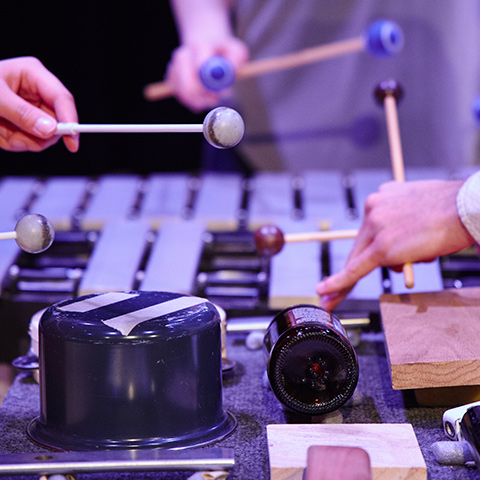
American composer Lou Harrison is one of the fathers of the modern percussion ensemble. He was a prolific and influential composer, performer, and mentor who was heavily influenced by non-Western musical traditions, drawing extensively from the timbres of African, Indonesian, Native American, and Latin American instruments. His works contain many “found instruments” such as metal pipes, flower pots, and metal trash bins, which add both rhythmic and melodic substance to the music. The combination of Western compositional techniques and a highly personal sonic palette has resulted in a rich and profoundly moving contribution to the repertoire. This concerto was written for solo violin and percussion orchestra. The work is in three movements and incorporates several “found instruments” that draw heavily on non-Western sounds, especially those of the gamelan ensembles of Java and Bali. The result is music of such exotic beauty that it transports the listener to distant places and invokes ancient, spiritual cultures.
—Notes by the “President’s Own” United States Marine Band