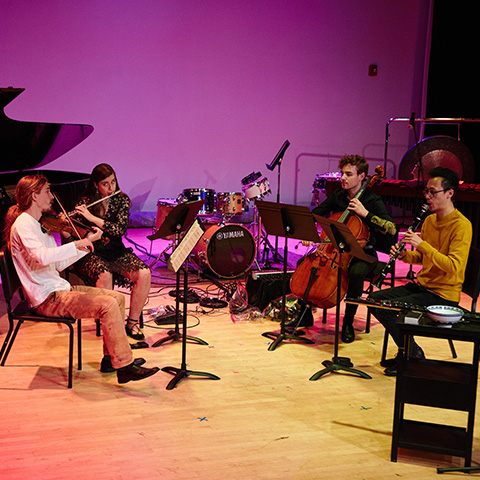
KEERIL MAKAN (b.1972): After Forgetting (2009)
The title, After Forgetting, might refer to the mental confusion of feeling like you’ve just forgotten something, the “it’s on the tip of my tongue” phenomenon. I go through a litany of techniques trying to grasp what I think I’ve forgotten—recite the alphabet and hope that the correct first letter of the forgotten word or idea triggers the memory; go over every previous thought and event in order, hoping this will lead me to the forgotten memory; try not to remember and hope that it will pop into my head without my trying; rearrange my memories hoping that an unusual juxtaposition will spark my memory; or simply wrack my brain, trying through sheer force of will to pull the memory from the depths of my brain. Sometimes, though, I wonder if I haven’t forgotten it all, but the thing I’m trying to remember is so insignificant that it can’t be the thing I’ve been trying to remember.
There may be different levels of forgetting. Sometimes you want to forget something so that you can move on in life. But it’s too important to forget at the deepest level; it just needs to be removed from the top level of your brain. The title might also be referring to this.
After Forgetting is a Meet the Composer/Commissioning Music USA commission. It was written while in residence at the American Academy in Rome.
—Keeril Makan
VIET CUONG (b. 1990): Electric Aroma (2017)
“an electric aroma, a most disagreeable noise” —Pablo Picasso, October 10, 1936
MICHAEL GILBERTSON (b. 1987): Breath and Shadow (2010)
The commission for this unusual instrumentation was delivered with an equally unusual challenge to compose a work based on canonic composition and which utilized canons throughout the piece. A canon is, in a sense, the musical equivalent of a shadow, casting a musical trail between two voices or instruments. The title of this work, Breath and Shadow, is a phrase borrowed from Sophocles, who once wrote that “human beings are only breath and shadow.”
—Michael Gilbertson
Julia Wolfe (b. 1958): Singing in the Dead of Night (2008)
The title, Singing in the Dead of Night, conjures up the still and surreal nighttime experience of being the only one awake. Out of the silence often comes inspiration±finding one’s way to a human song, symphony of sound. Singing in the dead of night is its own metaphor—beginnings always beginning in ”the dead of night”—in the void into which a creation is made. The virtuosity and intensity of the music are inspired by the high voltage performers of eighth blackbird. The silences, sand, and density are there for the thoughtful and exquisite Susan Marshall.
—Julia Wolfe