
Reading the Room
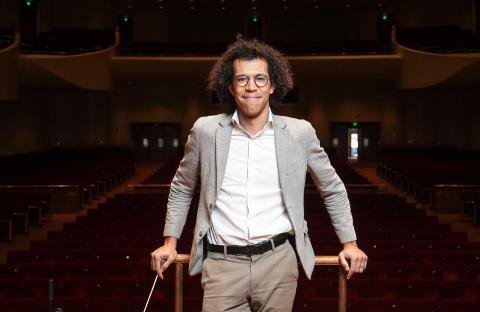
Jonathon Heyward in Joseph Meyerhoff Symphony Hall, home of the Baltimore Symphony Orchestra.
Photo by Jessica Gallagher/The Baltimore Banner
No matter what question you ask Jonathon Heyward (BM '14, cello), the answer will most likely circle back to a singular concept: listening.
This should come as no surprise given his role as conductor and music director of two major US orchestras, the Baltimore Symphony and the Festival Orchestra of Lincoln Center (as well as countless guest conducting jobs throughout the US and Europe). The profession requires sensitive ears. And once you’ve spoken with Heyward for, say, five minutes, it’s clear he possesses remarkable sensitivity, attuned not only to musical expression but to all varieties of human communication. He reads people as well as scores. But it may surprise you a little to learn who Heyward is listening to.
Beethoven, Mahler, and Shostakovich? Of course. Contemporary composers like Hannah Kendall and James Lee III? Enthusiastically, yes. Every single musician in every orchestra he’s ever conducted? Obviously. Dyed-in-the-wool critics and gatekeepers of “high” culture? Not so much.
Still, there’s another essential constituency you might be forgetting—one that Heyward hears better than most. He listens to audiences. And not just the super well-versed, longtime aficionados of classical music. He also listens to newbies, the classical-curious, and people who’ve never set foot in a symphony hall for whatever reason, whether they found the environment intimidating or lacked the means to pay.
“A concert hall should always be a community center … where your community comes to be fulfilled, to feel a sense of belonging,” Heyward says.
The potential to connect with an audience begins the second they set foot in the door, and as music director, Heyward concerns himself with the entire experience—from the reception area to the concert hall and back out again. “What are you feeling? What are you receiving instantly? There’s something about that I’m constantly thinking about with every orchestra that I work with,” he says.
Meeting Audiences Where They Are
Heyward began his tenure with the Festival Orchestra of Lincoln Center during a pivotal time, as the institution took stock of its relationship with audiences and shifted toward “prioritizing programming that is reflective of New York’s global communities,” says Shanta Thake, Lincoln Center’s chief artistic officer. In 2024, the center revamped its longstanding summer classical festival, Mostly Mozart, and launched the Festival Orchestra of Lincoln Center in its stead, with Heyward as the Renée and Robert Belfer Music Director.
“A core part of our mission is to create spaces where people don’t just consume art, but feel deeply welcome,” Thake says. “This is how an institution remains vital—because we serve all New Yorkers.”
Heyward guest conducted Mostly Mozart in 2022, and “there was an immediate, palpable energy between him and the musicians,” Thake says, adding that Heyward is uniquely suited to lead the orchestra in its next iteration. “He is totally nimble, with a blend of repertoire knowledge, dynamic programming instincts, and an innate ability to meet audiences where they are.”
Heyward was 10 years old and just three months into his cello studies when he applied to an arts magnet school in his home state of South Carolina. His acceptance to its middle school music program set him on a path that neither he—nor anyone else in his family—could ever have imagined. His parents ran a local diner where his father was a cook, his mother was a waitress, and Heyward himself would help out from time to time. Although his parents enjoyed music, they didn’t have much interest beyond listening to classic rock and jazz.
“If I wasn’t at the Charleston County School of the Arts, I wouldn’t have found my love for classical music, and I wouldn’t have picked up conducting for sure,” he says. In that supportive community of “musical and artistic geeks,” Heyward found his people. “I was really, really lucky,” he says.
Via the magnet school, Heyward was introduced to expressive art forms that he hardly knew existed. He also befriended and collaborated with students from every corner of Charleston County. “It was very much a melting pot of people from different socioeconomic backgrounds, and religion, race, creed, you name it,” he says. “What that showed me at such a young age is the unity of—and power and responsibility of—the performing arts.”
Heyward was catapulted into the professional conducting world after winning the Besançon International Conducting Competition in 2015—just a year after graduating from Boston Conservatory with a bachelor's degree in cello performance, and only midway through a master’s program in conducting at the Royal Academy of Music in London. Numerous guest conducting performances throughout Europe and the US eventually led to a four-year job as chief conductor of the Nordwestdeutsche Philharmonie in Herford, Germany.
In 2022, Heyward made history when the Baltimore Symphony Orchestra (BSO) named him as the first person of color ever to serve as its music director and the youngest person (at age 29) to be appointed music director of any major US orchestra. He was hired at Lincoln Center two years later, and in 2025 the role of artistic director of the Festival Orchestra was added to his title. The two positions are contracted through 2031 (at the BSO) and 2029 (at Lincoln Center).
Expanding the Conversation
As he rose steadily to international prominence, Heyward found that the classical music world did not always measure up to the inclusive, egalitarian principles he saw in Charleston as a child. “When you become a part of the profession, you realize that there are stigmas,” he says. “As I go through it, I constantly think to myself, ‘But why? What is the barrier? … Why is this the case—when I grew up in a world surrounded by this idea that [classical music] could be and should be for everyone?’”
These questions have fueled Heyward’s repertoire choices and sparked innovations in concert programming—particularly at Lincoln Center, where Heyward finds himself aligned with the institution’s ambition of “expanding the conversation around classical music while honoring its foundations,” as Thake says. This includes broadening the Festival Orchestra’s repertoire to incorporate new works like Huang Ruo’s immersive soundscape, City of Floating Sounds, which literally pushed the aural boundaries of David Geffen Hall. It also includes a choose-what-you-pay ticket pricing structure, “which has helped bring large numbers of first-time concert-goers, as well as multigenerational audiences,” Thake says.
While some have bemoaned the loss of the longstanding festival that was “mostly” Mozart, Heyward believes that traditionalists have nothing to fear, as the classical art form must evolve to survive. “If we don’t give life to that, then we’re not a part of the evolution, which is really important,” he says.
With the Festival Orchestra, audiences will have the opportunity to discover the Mozart of their time, thoughtfully paired with repertoire by composers who fit squarely within the canon. “It’s all about bringing relevancy to each other, rather than a sort of silo situation—which doesn’t make any sense when you’re thinking about music,” he says. “Music isn’t a silo.”
Heyward has a better metaphor. “Most often, a huge Venn diagram is what I see it as,” he says. And he has lived his musical life in the overlapping circles, “this beautiful, evolving collection of worlds that really kind of morphs into one.”