
Ready for Her Take

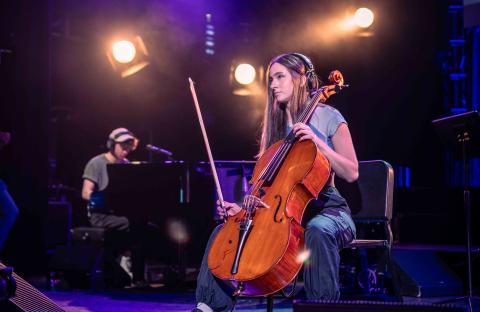
Photo by Mason Davis
When cellist Elaina Spiro (BM '24) was an undergraduate at Boston Conservatory, she dutifully attended music industry panel discussions and all manner of Berklee Career Center events, collecting advice that might someday help her gain a foothold as a professional session musician. Mindful of networking and very much a people person by nature (“I need a little more stranger danger,” she jokes.), Spiro rarely passed up the chance to chat with panelists afterwards, making herself known to pro musicians, composers, and producers in the screen scoring business.
“If you do get the opportunity to be introduced to someone, never let them forget you,” Spiro says. It’s a philosophy that suits both her lowkey persistence and disarming friendliness, and it has carried her far since she graduated from the Conservatory in 2024.
Effective networking—paired with top-drawer musicianship—has led Spiro from one professional session job to another, and has steadily built her a list of credits that include the blockbuster video game Battlefield 6 and the feature film Gabby’s Dollhouse—all while pursuing her master’s degree in cello performance at USC’s Thornton School of Music.
One of the many industry people that Spiro met at Berklee was the Grammy-winning producer Steve Schnur, worldwide executive and president of music at Electronic Arts, the video game company behind Madden NFL, The Simms, and the Star Wars gaming franchise. Spiro was introduced to Schnur through her teacher Sean McMahon, chair of screen scoring at Berklee College of Music; and after their initial meeting, she did what career counselors always tell students to do: She followed up. Schnur put Spiro in touch with contractors who do the hiring for sessions in Nashville and Los Angeles, and by summer 2024, she had lined up her first professional recording session.
After that, it was only a matter of months before Spiro was hired for a session Schnur was coproducing at Ocean Way Studios in Nashville. Needless to say, the worldwide executive had not forgotten her. “He saw me, and he was like, ‘I knew you were gonna get here one day,’” Spiro says. “It was great because I got to surprise him, like, ‘I did the work! I found my way into your session!’”
Schnur’s Battlefield 6 recording was actually Spiro’s seventh or eighth time working at Ocean Way, birthplace of platinum albums by everyone from Merle Haggard and Dolly Parton to Taylor Swift and Beyoncé. Her very first professional session—the one she landed thanks to connections made through Schnur—had also been in that storied space, an auspicious and somewhat daunting location for her pro recording debut.
For that first job, Spiro played on an album of sports-themed music written by composer and broadcaster John Tesh, the self-evidently titled Sports. Though she doesn’t consider herself a huge fan of athletics, Spiro says her brothers were particularly impressed that the session included Tesh’s most beloved composition for television, “Roundball Rock,” theme song of the NBA on NBC, and inspiration for an all-timer of a Saturday Night Live skit starring Jason Sudeikis as Tesh.
A Familiar Place
Though a bit overawed by Ocean Way's legacy—and the seasoned veterans surrounding her in the studio—Spiro says she felt confident in her playing, thanks to hands-on experiences she gained as a student. She twice had the opportunity to record at Berklee NYC’s elite Power Station Studios. And, by cross-registering in McMahon’s Film Scoring Studio Orchestra course at Berklee College of Music, she was able to collaborate regularly with screen scoring students, recording their compositions on campus in Boston.
“That class had me in a headset every week, so I got really familiar with the process of being recorded.” By the time she got to Ocean Way, Spiro says, “I really did feel like I knew what I was doing, because I’d done it before.”

The accessibility of Berklee’s studios gave Spiro enough experience to feel at ease while recording, so that she could put her cello skills front and center. “I see Elaina’s success as being an example of what is possible because of the merger—the fusion of rigorous conservatory training with contemporary learning experiences like recording film music in a studio environment,” McMahon says.
Both McMahon and Spiro’s cello teacher, Rhonda Rider, emphasize that professional networking is a necessity meant to serve one’s talent—to ensure that countless hours of practice get the chance to pay off. To that end, Rider poses clarifying questions about students’ professional goals, moving beyond the basic, What do you want to do?, to the more concrete: Does anybody know you want to do that? Well, then, who should you be talking to? “And don’t be shy about saying it,” Rider says. “Without being aggressive, but just saying, ‘Hey, this is really what I’d love to do.’”
Spiro took this advice and ran with it, consistently working on her musicianship all the while. The summer before her first Ocean Way job, for instance, she practiced sight reading every day so that when session work came along, she would feel prepared for whatever was put on her music stand. When preparation eventually met opportunity, Spiro was raring to go.
“I see Elaina’s success as being an example of what is possible because of the merger—the fusion of rigorous conservatory training with contemporary learning experiences like recording film music in a studio environment.”
—Sean McMahon, Chair of Screen Scoring
Professional Contacts, Potential Friends
Over time, Spiro’s proverbial Rolodex has grown exponentially. She is always introducing herself, at studios on Music Row, on motion picture scoring stages in Hollywood, on campus at USC, and most everywhere she goes. A friendly hello at a merch table after a concert once led her to record with an artist she admires. In similar fashion, she approached members of the chamber ensemble Salastina after a performance, and offered to join their volunteer effort, Vital Sounds, playing music for patients hospitalized in intensive care.
Spiro aims to connect with people not just as professional contacts but as potential friends. And she follows up with kindness, remembering birthdays, meeting folks for coffee, and taking genuine interest in their work. With her graduate program coming to an end this spring, she’s counting on those relationships to sustain her through whatever move she makes next.
“As long as I have my career and my community, wherever that ends up being, I’ll be happy,” she says.
For now, Spiro is making the most of her time in LA, where signs of her recording work seem to pop up everywhere: hearing “Roundball Rock” on TV, for instance, or seeing billboards for Battlefield 6 around the city. “It’s funny, because I’ll go to Target and see a Gabby’s Dollhouse doll, and I’m like, oh my gosh,” she says. “There’s so many reminders that I’m living my dream. Just there in the grocery store.“
Odds are excellent that before she leaves the supermarket, Spiro will have made a new friend.
Quick Takes | Elaina Spiro’s Guide to Networking
Pushing through the awkwardness of that first hello is the only way to connect with someone new, Spiro says. Here, she shares some advice on how to do this, but she is quick to share credit for these insights with her mentors. “I’ve been lucky to have amazing people who’ve given me their takes,” she says. “So, anything I’m going to relay is advice from others, mixed with my own little ‘sparkle,’ if you will.”
- Never let people forget you. If you send that first hello email, what’s the worst that happens? You never hear from them again. But if you don’t send it, you’re not hearing from them anyway.
- That first uncomfortable conversation is never going to feel comfortable. You have to tell yourself, “This is okay.” It’s uncomfortable, innately, because how do you create connection with someone you have no connection to?
- Stand by the door. Say hi. Not everyone is going to latch onto that, but you can’t take it personally.
- You need a quick rebound. I’ve had conversations with people who you could tell didn’t want to talk to me. But then you move on, like, “Okay, we’re not gonna connect in this way.” And then you meet the next person, and you try again.
- A conversation doesn’t have to prove anything about yourself. People put a lot of pressure on themselves to come off as funny or personable—or say something impressive—so they don’t seem embarrassing. But I have lost my “embarrassing bone” in my body, because I say embarrassing things all the time to really amazing professionals. And then I just sit back up and try again.
- You have to be a friend. And that’s something you can work on, but it also has to be something you do actually care about. I’m always messaging people, letting them know I exist—but letting them know that I see their existence as well. Be interested in their work.
READ: STAGES 2026
“Ready for Her Take” first appeared in the 2026 issue of STAGES, Boston Conservatory’s annual magazine.