
Taking the Stage at Carnegie Hall—On a Global Scale

Boston Conservatory Orchestra performs for a sold-out audience at Carnegie Hall, under the baton of Maestro Jorge Soto.
Photo by Ryan Nava
Viola graduate student Kate Rose Bennett (MM '26) was running the final movement of Beethoven’s Symphony No. 9 with Boston Conservatory Orchestra during soundcheck on the fittingly epic Carnegie Hall stage when, she says, it struck her: “We were being treated like professionals.” Having had just one rehearsal with renowned soloists Karen Slack, SarahAnn Duffy, Corey Leak, Sidney Outlaw, and the Columbia University Teachers College Chorale, she explains, “We had to be so prepared ... and trust that [everything] would come together just hours before the performance.”
In a milestone moment, Bennett and her Boston Conservatory Orchestra colleagues took the stage at Carnegie Hall on December 5 as part of Building Our Future Together, an event presented by the United Nations Institute for Training and Research (UNITAR) in celebration of the 80th session of the United Nations General Assembly.
With global leaders in the audience, the orchestra performed works by Florence Price and Sergei Rachmaninoff, closing with a soaring Symphony No. 9. The concert highlighted not only the ensemble’s artistic excellence but also Boston Conservatory’s commitment to providing opportunities for students to use their artistry as a force for global connection and civic engagement.
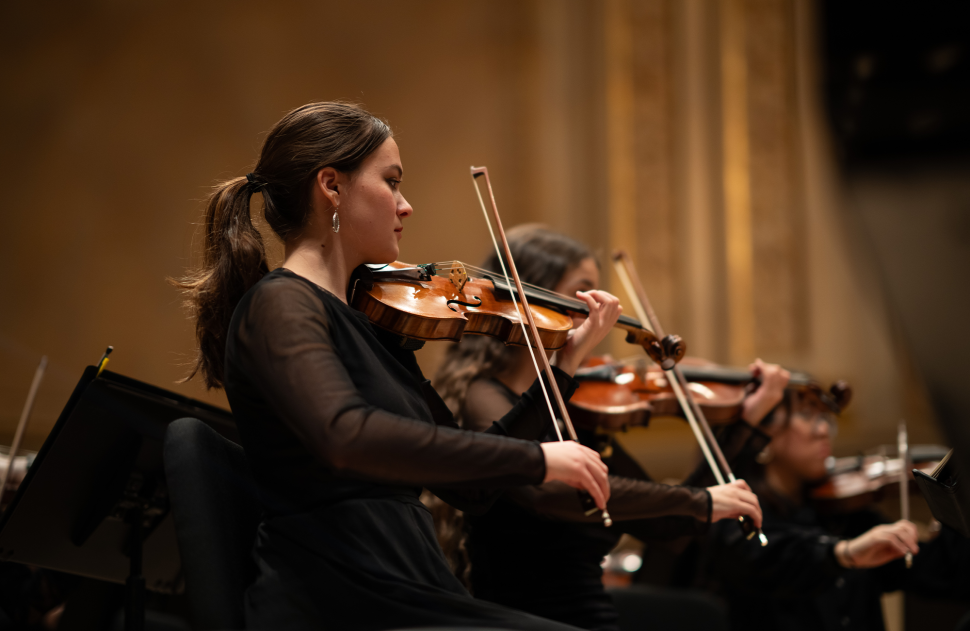
Violin student Bella Yee. (Photo by Ryan Nava)
For Bella Yee (BM '26, violin), who served as concertmaster, representing Boston Conservatory on one of the world’s most iconic stages was quite surreal. “I never imagined in my time at BoCo that I would get to be concertmaster at Carnegie Hall for such a high-profile event,” she reflects. According to Yee, performing on such an important stage raised the level of focus for the entire orchestra, noting the “different energy compared to other school performances” that it carried. “In rehearsals, there was a heightened sense of awareness that every single musician brought—really focused and also really excited.”
Performing a complete symphony for the first time gave flutist Maggie Stuteville (BM '27) insight into the level of preparation required in professional orchestral work. “Being trusted with an opportunity like this made me more confident in myself and my preparation,” she explains. Similarly, Bennett notes how the experience provided a glimpse into professional scenarios and reinforced the importance of individual accountability within a large ensemble—an essential skill for any professional musician.
Stuteville adds that the prestige of the performance brought her to reflect on her impact as an artist on a grander scale. “I wasn’t just thinking about playing well, but about representing something larger than myself. That definitely changed how focused and intentional I was in rehearsals.”
“I wasn’t just thinking about playing well, but about representing something larger than myself.”
—Maggie Stuteville (BM '27, flute)
For Yee, the concert underscored music’s power to build community. “Music serves as a way to bring people of all different backgrounds and ideologies together,” she says. “A performance at an event that represents global unity is one of the ways these communities start to become interlinked.”
Bennett notes a profound connection between Symphony No. 9 and the impact of their performance. “Maestro [Jorge] Soto pointed out that Beethoven composed such a joyful piece at a terribly dark time in his life. Spreading this message of hope to world leaders during the holiday season felt so significant and important.”
Reflecting on the broader significance of the collaboration, Matthew M. Marsit, chair of instrumental studies at Boston Conservatory, emphasized the importance of the partnership itself. “It is meaningful that the United Nations and UNITAR, upon learning of the mission of Boston Conservatory at Berklee, approached us with this important opportunity, and maintains an open door for future exchanges,” he says. Marsit adds that experiences like this extend well beyond a single performance, noting, “Through this, we are building new networks for our students to explore as they enter the professional world.”
“It is meaningful that the United Nations and UNITAR, upon learning of the mission of Boston Conservatory at Berklee, approached us with this important opportunity. Through this, we are building new networks for our students to explore as they enter the professional world.”
—Matthew M. Marsit
For these students, the Carnegie Hall performance was more than a prestigious concert—it was a formative professional experience that combined artistic excellence, personal growth, and a poignant sense of purpose. As Boston Conservatory at Berklee continues to engage with opportunities that connect the arts and global citizenship, moments like this reaffirm the role of young artists as both performers and cultural ambassadors.
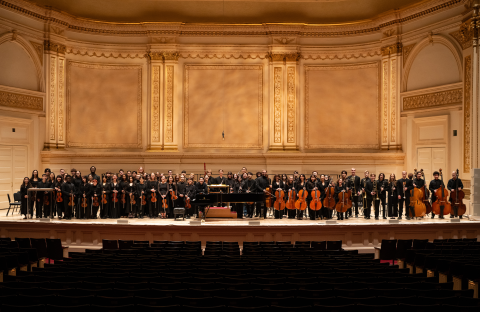
Boston Conservatory Orchestra gathers during rehearsal at Carnegie Hall. (Photo by Ryan Nava)
Sign up to learn more about our leading undergraduate and graduate music programs.