
Signature Style

Commercial dance students perform Fosse’s “Beat Me Daddy, Eight to the Bar" as part of the 2026 Commercial Dance BFA Concert.
Photo by Eric Antoniou
Art moves through history in evolutionary fashion—across genres and generations to create new forms over time. Certainly no individual artist or work, however trailblazing they may be, can claim to be truly original in this process. But when a single body of work is so influential that it permeates through the dance world, Broadway, and the film and music industries, how do you ensure that it continues into posterity with its artistic integrity intact?
Boston Conservatory at Berklee Dance Division students have been charged with precisely this task, thanks to a groundbreaking five-year partnership with The Verdon Fosse Legacy, founded by Nicole Fosse to preserve and reconstruct the work of her parents, dance visionaries Bob Fosse and Gwen Verdon.

Photo by Johanna Snow
Fosse’s signature style—despite its emphasis on subtle, precise, isolated movements—forged a massive and ever-expanding cultural footprint that remains vitally present today. As a director and choreographer, Bob Fosse’s longstanding artistic collaboration with his wife, dancer and actor Gwen Verdon, fueled legendary Broadway productions like Chicago and Pippin and revolutionized the onscreen presentation of dance with films such as Sweet Charity and the Oscar-winning Cabaret. They pioneered both cinematic and choreographic techniques that became foundational to the nascent music video industry—as well as the dance vocabulary of Michael Jackson, Beyoncé, Lady Gaga, and countless others.
As so-called “Fosse style” circulated in all directions of the cultural mainstream, the highly technical and nuanced movements associated with it at times became diluted, reduced to the visual clichés of jazz hands and bowler hats. To protect the integrity of her parents’ technique and the ethos behind it, Nicole Fosse established The Verdon Fosse Legacy as a way to pass down and preserve their work.
“Educating the next generation is imperative to the continuation of this legacy,” says Nicole Fosse. “A multi-year partnership like this allows for a proper deep dive into the method, intention, and nuance that define these works.” As such, her organizationʻs collaboration with Boston Conservatory, launched in 2025, marks its longest artistic and educational partnership since the Legacy’s founding in 2013.
Teachers from The Verdon Fosse Legacy will be in residence at Boston Conservatory twice a year to reconstruct Fosse masterworks that will be performed at the school’s commercial dance and contemporary dance concerts. In the 2025–2026 academic year, two of its noted instructors—Mimi Quillin and Alyssa Epstein—came to campus to set iconic Fosse pieces with students.
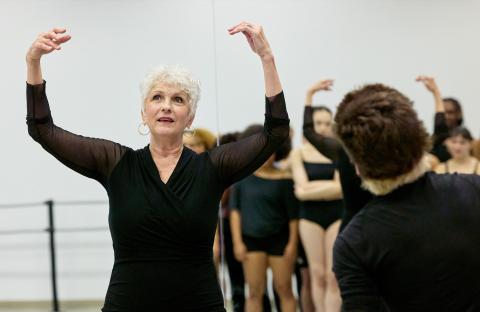
Mimi Quillin, a Boston Conservatory alum and teacher with The Verdon Fosse Legacy, works with Dance Division students.
Photo by Johanna Snow
Quillin has had close ties to both organizations: she is a Boston Conservatory alum who was personally invited by Fosse and Verdon to serve as dance captain for the 1986 Broadway revival of Sweet Charity. Working alongside the pair, Quillin witnessed their ineffable creative chemistry and was steeped in an atmosphere of meticulous intensity that shaped her as a professional performer.
And now, she and her colleagues are passing on that methodology and its guiding spirit to Boston Conservatory dance students. Noah Fosse (Nicole’s son, grandson of Bob Fosse and Gwen Verdon, and executive director of the Legacy) says, “Partnering with a program as well-respected as Boston Conservatory gives us unprecedented access to some of the most talented young artists in the country,” adding that “these students are versatile, curious, and hungry for the kind of layered, expressive training that Fosse’s work demands.”
“These students are versatile, curious, and hungry for the kind of layered, expressive training that Fosse’s work demands.”
—Noah Fosse
Student Tony Silvis (BFA '27, commercial dance), who worked with both Quillin and Epstein, noted how they “were exact with every bone in a dancer’s body,” in emphasizing “the discipline required to create the illusion of effortless movement.” He says that training with the two teachers “deepened my appreciation for the subtle details that elevate both performance quality and artistry.”
Silvis, who performed in “The Rich Man’s Frug” from Sweet Charity and “Beat Me Daddy, Eight to the Bar” from Big Deal during the Commercial Dance BFA Concert this past February, reflects on the enduring influence of this work: “[While] Fosse’s style continues to grow and adapt, the technique, inspiration, and artistry behind it remain timeless.”
Ensuring the continuity of art forms requires a delicate dance between tradition and innovation—a dynamic that captures the shared mission of both the Conservatory and the Legacy. As Noah Fosse says, “This partnership is vital not just for preservation, but for the evolution of the work itself.”
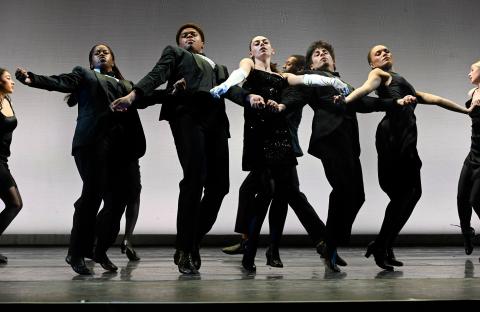
Photo by Eric Antoniou
READ: STAGES 2026
“Signature Style” first appeared in the 2026 issue of STAGES, Boston Conservatory’s annual magazine.