
Mapping an Education
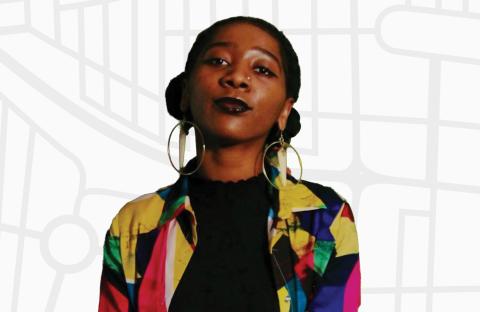
Chloe Clarke Smith
As an undergraduate studying composition at Boston Conservatory, alum Chloe Clarke Smith (BM '25) made the place her own. In the classroom, on stage, at her campus job, in her research, and even in her dormitory life, Smith approached her education holistically, stitching together a learning experience that engaged her deep curiosity about African diasporic art forms and her own place in the tradition of Black classical composers. This investigation, launched at Boston Conservatory, continues for Smith today as a graduate student at the Johns Hopkins Peabody Institute, where she received a full-tuition fellowship through their Pathway to DMA program.
Here’s how Smith tailored her Boston Conservatory experience, drawing from resources Berklee-wide.
Black Scholars Initiative
Just prior to her first year at Boston Conservatory, Smith attended a pre-orientation program as part of Berklee’s Black Scholars Initiative (BSI). With its strong focus on community-building and purpose-driven study of the African diaspora, BSI set her on a path of discovery, both personal and academic. It’s not a stretch to say that her very first week on campus shaped Smith’s entire undergraduate experience, and sparked a close mentorship with Dr. Emmett G. Price III, dean of Africana studies.
“Dr. Price was speaking about Africana studies and the research of Black American music, and I was really fascinated by that conversation,” Smith says. “I was like, ‘Can I meet with you? I have so many questions.’” As it goes with self-motivated learners, questions inexorably led to more questions, inspiring her compositions and still driving her research today at the Peabody Institute.
Africana Studies Programming
Smith didn’t just partake of the Africana Studies Division’s social and cultural event programming; she played a lead role in organizing it as a student employee. Alongside fellow program assistants (under the supervision of Tracy Gibbs, director of operations and programs), she helped the division put on events like the Afro Roots concert series and the annual back-to-school Black Joy Block Party—aimed to enrich and expand all students’ engagement with Black creative expression.
Living Learning Communities
Berklee’s Boston campus offers thematically focused housing for Boston Conservatory and Berklee College of Music undergraduates, with an eye toward keeping students connected beyond the classroom. Smith thrived as a residential advisor for the Africana Studies LLC, where her interest in classical composition blended with strains of jazz and R&B played by her dorm mates. Students from a wide range of majors shared common spaces in the residence hall, spending their downtime hanging out—and making music—together. “It was really nice getting that mix of people. You have producers, you have dancers, you have theater majors. It was really cool,” she says, “really community-focused.”
Piano Studies at Both the Conservatory and the College
Smith reinforced her composition studies with private piano lessons, diving deep into repertoire by composers she admired. Prompted by her teacher Carlos Vargas, assistant professor of music at the Conservatory, Smith hit the library in search of new music to work on, and stumbled upon a collection of pieces by Black women composers. “Somehow that was the first book that I found,” she says. “That started the flow of researching Black female composers more. It was really awesome because it was the most fulfilling for me performance-wise as well.”
Smith’s persistent research led to private piano studies with Berklee College of Music professor Karen Walwyn, recognized for her scholarship on the American classical composer Florence Price.
Composing for Student and Pro Ensembles
In her senior year, Smith wrote an original work for Boston Conservatory’s Composers Wind Ensemble, drawing inspiration from Paul Robeson’s signature spiritual “Nobody Knows the Trouble I’ve Seen.” The piece blended a recording of Robeson’s distinctively deep vocals with her own compositional ideas: “The first half of the piece, I’m arranging the ensemble to sound exactly like the spiritual. But in the second half, I let my own voice and my own harmony shine through,” she says. “I think that was the biggest moment for me. It was like, whoa, I’m involving what I’m learning in this minor into my own music, and making it all the more satisfying and richer.”
Smith also got the opportunity to compose for professional ensembles, including Yarn/Wire and Sound Icon, and “each one gave me more of a chance to perfect my coaching skills,” she says. “It’s really important, as a composer, to be able to tell someone how you want your music to be performed.”
The Africana Studies Minor
Smith was among the first Boston Conservatory students to graduate with a minor in Africana studies, and what she learned in those courses changed her relationship to music making. One class in particular, Women in Africa and African Diasporic Cultures with Associate Professor Aminah Pilgrim, brought invaluable context to her compositions. “I was learning so much about the harmonies of West African music, and how the music changed and transformed and evolved during slavery, and then how the birth of spirituals came to be,” Smith says. Inspired by what she heard—and equipped with a more diverse sonic palette—she found new ways to express herself compositionally.
From Minor Capstone Project to a Major Film Festival
For her minor capstone project, Smith made a short film under the guidance of Assistant Professor Martin Shore, whose Take Me to the River seminar teaches students to create “living documentaries,” treating life stories as if they’re living things, “like something that you can watch grow,” Smith says. Her film, She Is Music, shared perspectives of Black women in higher education, and featured interviews with Dr. Lenora Helm Hammonds, dean of Berklee College of Music’s Professional Education Division, and Idriemeka Bailey (BM '26), who studied trumpet at the college. About a month after graduating from Boston Conservatory, Smith flew to London to attend the premiere of her film at Raindance Film Festival, where she walked the red carpet with Shore and Dr. Mike Mason, chair of Africana studies.
The film includes an original composition by Smith, “Kindness,” which she performed alongside Bailey, her friend and dorm mate from the Africana Studies LLC, and, in a sense, it encapsulates her undergraduate experience at Boston Conservatory: celebrating Black culture while posing questions about the persistent effects of the African diaspora on American life—in her own compositional voice.
READ: STAGES 2026
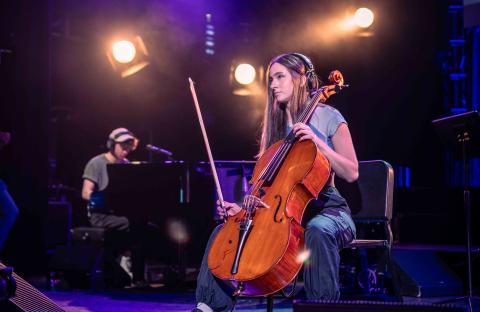
“Mapping an Education” first appeared in the 2026 issue of STAGES, Boston Conservatory’s annual magazine.