
Boston Conservatory Orchestra—Musical Journeys Then and Now
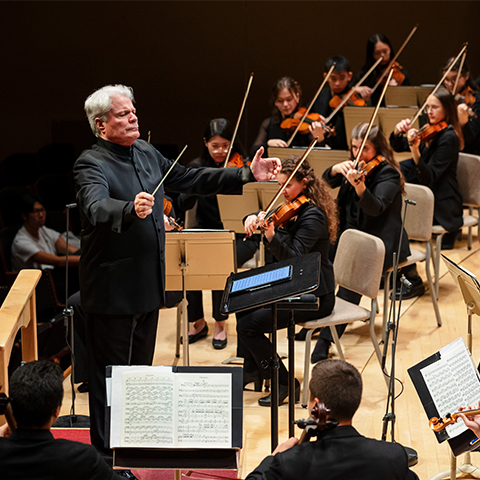
The Boston Conservatory Orchestra in concert will showcase the dramatic Symphony No. 6 by Tchaikovsky, along with a celebratory performance by the winner of the Conservatory’s 2025–2026 Orchestra Concerto Competition.
Berklee students, faculty, and staff can claim two comp tickets in person at the Symphony Hall Box Office by presenting their Berklee ID.
Program Information
Repertoire
I. Adagio – Allegro non troppo
II. Allegro con grazia
III. Allegro molto vivace
IV. Adagio lamentoso
FRYDERYK FRANCISZEK CHOPIN (1810–1849): Piano Concerto No. 1 in E Minor, op. 11 (1830)
I. Allegro Maestoso
II. Romanze – Largetto
III. Rondo – Vivace
Anru Zhang, BM '29, soloist
Program Notes
The final work of Pyotr Ilyich Tchaikovsky is still to this day shrouded in mystery. From its enigmatic, programmatic moniker “Pathétique” to its coincidental timing of the premiere nine days before the composer's death, this work is a testament not only to Tchaikovsky’s late compositional style but to the composer’s complex musings on his own mortality. Throughout the last decade of his life, strife and pessimism seemed to take over, with the death of friends such as Anton Rubenstein (1835–1882) and Iosif Kotek (1855–1885), the diminishing support of his longtime patron Nadezhda von Meck (1831–1894), the fading of his own health, and his complex interpersonal relationships. All of this culminated in Tchaikovsky’s interests in the philosophical distinction between the sacred and profane as well as an acceptance of mortality.
Though originally intending to compose a grand symphony to conclude his compositional output and dedicate it to the tsar, he scrapped these initial sketches after enduring much personal strife. Instead, he replaced the grandeur of these initial sketches with ones full of poignant emotions and passionate vulnerability. Tchaikovsky acknowledged the existence of a programmatic theme to the symphony, which was revealed only to his nephew, Bob, as he wanted it to remain enigmatic. Despite this, the thematic details and expressive markings in the score reveal that this symphony is rife with themes of passion, suffering, and valediction—reflective of his mindset at the time. These themes are echoed in the symphony’s title “Pathétique,” meaning “passionate” or “impassioned suffering,” reaffirming the musical themes rich with tangible emotions. Some speculate that the symphony acts as Tchaikovsky’s premonition of his own death, or even a suicide note, as no one truly knows why Tchaikovsky died. Scholars from multiple fields still debate whether he died from cholera, was poisoned by arsenic, or committed suicide due to the threat of exposure of his homosexuality. Even with the uncertainty of the cause of his death (and the truth may be “in-between”), the “Pathétique” Symphony is more than an enigmatic piece, but one that encapsulates the passionate style of Tchaikovsky as well as the intense vulnerability of his late works.
The first movement’s Adagio introduction ushers in the sentiment of despair and darkness with an ominous lamenting bassoon solo. The following Allegro offers a new anxious and grasping theme, first articulated in the violas, that builds into a frantic energy with the entire orchestra taking up the theme. This anxiety fades into a yearning second theme, pulling at the heartstrings in classic Tchaikovsky fashion. These two ideas are developed and intertwined with musical allusions, such as a brass chorale intoning a hymn from the Russian Orthodox Requiem. As the tumultuous emotions settle, the first movement closes with a hopeful wind chorale that settles the anxiety for the moment. The Allegro con grazia opens with a lilting and tender waltz in an unexpected 5/4 meter. Yet, the central section, marked “with sweetness and mournfully,” contrasts this lighter dance with a lamenting, falling line—reminiscent of the first movement’s sorrow. Within this despondent texture is the beating timpani in piano, imitating a thumping heart and ominous foreboding into the movement’s original charm.
Following this charismatic waltz is a driving, playful, and infectious scherzo. With its shifts from driving marches to skipping melodies to its heroic chorales, this third movement rouses ferocity and glory compared to the previous movements. This disjointedness between the first two movements and the third is characterized by some critics and audiences as confusing. Musicologist David Brown, however, sees this movement as “a desperate bid at happiness so prolonged and vehement that it confirms not only the desperation of the search, but also its futility.” The movement drives to the close with grandeur and a sense of finality, often leading to premature cheers.
Despite the celebratory ending of the third movement, the finale is one of intense, profound, and intricate emotion. Unlike the traditional virtuosic finale, this movement is marked Adagio lamentoso, underscoring the despair and melancholy of the movement. Opening with a longing, descending theme in the strings, this movement is deeply personal and vulnerable with its relentless falling melodies and dark harmony. The second theme echoes the despair of the opening theme with its somber tone, yet offers a more lyrical cry of sorrow and goodbye that builds in tension, and performing forces that eventually succumbs to the power of fate. In its final notes, the movement closes with gently pulsating Bs in the double basses, fading into silence and darkness as this heartbeat comes finally to rest.
—Stella Felliberti (BM '27)
FRYDERYK FRANCISZEK CHOPIN (1810–1849): Piano Concerto No. 1 in E Minor, op. 11 (1830)
Though considered “immature” by critics of the time, Fryderyk Chopin’s Piano Concerto No. 1 reveals the complex and tender style that he cultivated throughout his career. Chopin composed his E-minor (op. 11) and F-minor (op. 21) concerti at age 20 for a series of concerts at the National Theatre in Warsaw. Prior to this, Chopin had concertized across Poland, playing for a variety of aristocratic families, and he began making a public name for himself as both a pianist and composer, so much so that even Robert Schumann exclaimed, “Hat’s off, gentlemen, a genius!” Yet, even with such praise, Chopin still struggled with his rapid rise to fame; he desired for a life not just as a pianist-composer but to forge a path beyond the restrictions of narrowly defined “composer-performer” roles—one full of fantastical romanticism and improvisatory expression.
The Allegro Maestoso opens with a dramatic and lengthy orchestral introduction, with its repeated tutti figures, large dynamic contrasts, and diverse phrasing between dignified and flowing melodies. However, the second theme is sweet and lyrical, and in a curious key of E major rather than the expected G major; it is only in the recapitulation does this theme appear in the expected G major, showcasing Chopin’s unique harmonic expression. The soloist takes the orchestra’s drama and ups the ante with improvisatory ornamentations to highlight the soloist’s own musical flair. With the soloist’s entrance, the style changes from large-scale to intimate drama, shifting the focus to the prowess of the pianist’s technique and expressiveness, much like the solo piano music of Chopin. Even with this emphasis on pianistic expression, Chopin’s reflective romanticism shines through in the rapturous Romance – Larghetto. Starting with a nocturne-like theme, the soloist’s enchanting line enraptures the musical atmosphere with intimacy and fantasy. After settling into a slumber, the finale interrupts the serenity of the Romance with declamatory chords in the orchestra. This mood does not last, as when the soloist enters, Chopin reveals that this finale is a playful, virtuosic rondo. With each contrasting theme adding a new level of charisma, vivacity, and technical dexterity, this final rondo builds into a florid and flashy coda that drives the piece to a showstopping finish.
—Stella Felliberti (BM '27)
Ensemble
CONDUCTOR
Bruce Hangen
PICCOLO
Teo Mondiru, BM '28
FLUTE
Sabrina Clubine, MM '27
Dayna Dengler, BM '26
Teo Mondiru, BM '28
Maggie Stuteville, BM '27
OBOE
Isabella Guevarra, BM '28
Christopher Mavrogian, MM '26
J.D. Uchal, MM '26
CLARINET
Michael Fascetta, MM '26
Rose Lao, MM '26
Jiahua Qiu, MM '26
Jiaxiang Zhao, BM '29
BASSOON
Matthew Gaudio, BM '28
Carson Saponaro, BM '26
Kyle Sodman, GPD '26
Alexander Weber, BM '27
HORN
Holly Fullerton, BM '26
Drew Lingenfelter, BM '28
Cameron McCarty, GPD '27
Ricardo Verde, BM '26
Zach Watson, BM '27
TRUMPET/CORNET
Emilly Dillon, BM '27
Charlotte Berube-Gray, BM '25
Teddy Mason, MM '27
Freddie Poor, BM '27
TROMBONE
Collin Good, BM '26
Carter Lepuil, BM '29
Kevin Smith, MM '26
Brooke Thomson, BM '26
TUBA
Lowrider James, BM '27
PERCUSSION
Jin Cho, BM '26
Lily Cooper, BM '28
Jialu Du, BM '26
Grant Mellone, BM '27
VIOLIN I
Jocelyn A. Wang, MM '26
Acadia Kunkel, BM '28
Stella Feliberti, BM '27
Emily Tang, MM '26
Ha-Min Lee, BM '29
Serene Sung, BM '28
Zhuoma Jianyong, MM '26
Shuyi Huang, MM '26
Spencer Lee, MM '27
Tian Tian, BM '26
Isabelle Parker, BM '28
Mia Widner, BM '29
Pippin Forrest, BM '27
Lazaro Manzano, GPD '27
VIOLIN II
Rose Barranco, BM '26
Melanie Ooi, MM '27
Fang-yu Lin, MM '26
Tony Hsu, MM '27
Lauren Oeser, BM '26
Raylene DeBenedictis, BM '29
Annali Wirtz, BM '26
Yen-Yu Kuo, BM '26
Tony Li, MM '26
Davis Albayeros, BM '29
Annabelle Lee, BM '27
Adrian Atonya, BM '26
Yuang Zhang, BM '29
VIOLA
Lydia Tan, BM '27
Maya Hartglass, BM '27
Katy Rose Bennet, MM '26
Webb Hiaasen, BM '27
Emily Tardiff-Rodriguez, MM '26
Jocelyn Scully, BM '28
Dylan Cogen, BM '28
Julian Bernal, BM '27
CELLO
Madeleine Corrigan, MM '26
Milla Chitwood, BM '27
Hailey Brasser, BM '26
Adam Broce, MM '26
Gretchen Grossert, BM '29
Abigail Clifford, BM '29
Ethan Lee, BM '27
Shuo-I Hsiao, BM '29
Yun Shang, BM '27
Enrique Garcia, BM '27
Nadia Brooks, MM '26
Tyler Hsu, BM '29
BASS
Zakar Basan Josiah Baiza, BM '27
Josiah Baiza, BM '29
Henry Jamison, BCM '27
SOLOIST
Anru Zhang, BM '29
Concert Services Staff
Coordinator, Concert Services – Matthew Carey
Concert Production Manager – Kendall Floyd
Performance Technology Technicians – Sara Pagiaro, Goran Daskalov
Boston Conservatory thanks audience members for viewing this program information online. This paperless program saved 300 sheets of paper, 31 gallons of water, and 27 pounds of CO2-equivalent greenhouse gas emissions.