
What Good Is a Conservatory Education in the Age of AI?
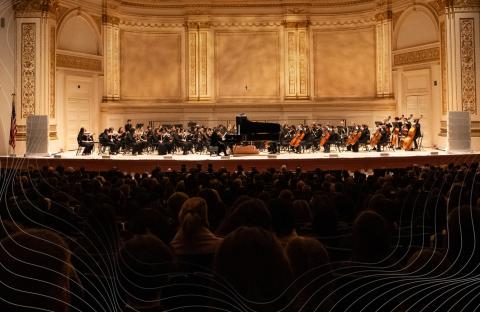
Boston Conservatory Orchestra performs at a sold-out Carnegie Hall in a concert titled Building Our Future Together, held in celebration of the 80th anniversary of the United Nations Charter.
Photo by Ryan Nava
We find ourselves at an inflection point: Artificial intelligence is advancing more rapidly than many of us could have ever imagined, and it is already forcing tectonic shifts in our way of life. With the speed of change and the countless predictions about the future of human endeavor, we are faced with a number of questions: How do we engage with AI? What will its impact be for us as performing artists and educators? Will it simply replace the creative work that we have spent our lives honing? Or will there be opportunities for us to harness it in innovative ways that will enable new modes of artistic expression?
While these important questions have rightly been the source of intense debate, it is clear that our most urgent task is to prioritize the fundamental human capabilities and experiences that make us who we are, as we define and critically examine how to ethically and responsibly engage with AI.
As the leader of one of the United States’ prominent performing arts conservatories, I pose the question: What good is a conservatory education in the age of artificial intelligence? Mark my words, it is infinitely more valuable than ever before.
The reality is, the fundamental skills our students develop here at Boston Conservatory are the very areas where AI falls short.
In fact, many thought leaders on the future of work (including some at the helm of AI companies) have pointed out that, as more and more tasks become automated, the skills that are becoming increasingly vital in the workforce are those commonly labeled “soft skills” (a misnomer if there ever was one): creativity, emotional intelligence, empathy, critical thinking, and the ability to connect, collaborate, and communicate. Another invaluable skill set—adaptability, improvisation, and presence—involves responding in real time to shifting, unpredictable contexts. This is where AI struggles, but as anyone who has ever worked on a dance, music, or theater production knows, it’s where conservatory-trained artists shine.
The very practice of artistic collaboration is, in the most fundamental sense, what has made humans so successful as a species. As musician David Byrne writes in the MIT Technology Review: “We have evolved as social creatures, and our ability to cooperate is one of the big factors in our success. I would argue that social interaction and cooperation, the kind that makes us who we are, is something our tools can augment but not replace.”
I would extend Byrne’s idea to say that artistic collaboration is possibly the most heightened expression of cooperation that we have the capacity to experience as humans. As an active pianist, I can recall many such moments on the concert stage, performing chamber music, when I experienced a particular magic that psychologist Mihaly Csikszentmihalyi coined as “flow,” a moment electrified by deep concentration and a sublime sense of connection with one’s collaborators, when time itself appears suspended. This magic extends to the audience, an experience so transcendent and uniquely human that it will never be replaced or truly felt by an alternative intelligence.
This is the unique power of the performing arts, particularly in these fractured times: to create connection and a sense of shared community that bridges divides. And Boston Conservatory at Berklee is committed to creating opportunities for our students to do just that. Here’s just one example: In December, the United Nations invited the Boston Conservatory Orchestra to perform at Carnegie Hall in celebration of the 80th anniversary of the UN Charter, the founding document of the UN. In a program entitled Building Our Future Together, the orchestra performed works by Florence Price and Sergei Rachmaninoff, culminating in a stunning performance of Beethoven’s Symphony No. 9—famously a call for unity and solidarity.
This event was a bold demonstration of students using their artistry as a force for global connection and civic engagement. As the flood of AI-generated content increases exponentially, these very real, live experiences will become even more critically important, as will community involvement at the local level.
To that end, our new program, Inspiring Hope and Leading Change (IHLC), enables Boston Conservatory students to be of service in our surrounding communities, using artistic expression to engage with our neighbors and create lasting social change. Through IHLC, we’re also strengthening cross-disciplinary connections with a new course launched this spring, The Artist Workshop: An Interdisciplinary Collaboration, required of all first-year students across our Dance, Music, and Theater divisions. The goal is for students to build human-centric, community-focused skills that they’ll continue to employ throughout their lives.
Meanwhile, on a broader institutional level, the new innovation hub Berklee Emerging Artistic Technology Lab (BEATL) is bringing artists and technologists together to give students access to next-gen creative tools, with artist advocacy and empowerment at its center. Experimental spaces like BEATL allow our students to responsibly engage with emerging tech tools so that artists shape the technology—not the other way around. And we will do so while doubling down on the power of the performing arts and the fundamental human skills that transform young people into world-class artists and builders of community.
READ: STAGES 2026
“What Good Is a Conservatory Education in the Age of AI” first appeared in the 2026 issue of STAGES, Boston Conservatory’s annual magazine.