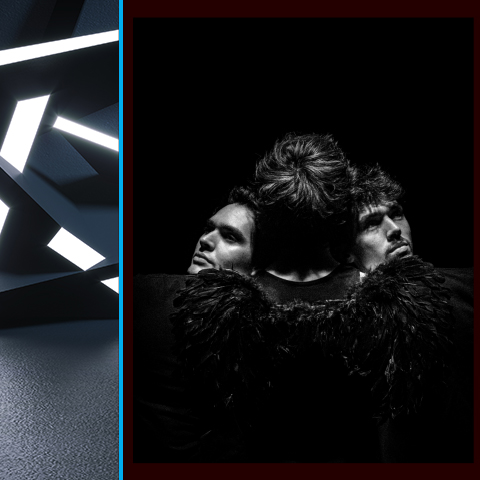
Pietro Montresor hates the carnival. There are too many people, too much chaos, and not enough wine. But when a mysterious fortune teller gives his younger sister some love advice, his life is catalyzed into a series of events that end with a corpse in a wall. Cask is a theatrical retelling of Edgar Allan Poe’s “The Cask of Amontillado,” which seeks to answer the story’s greatest question: What drives someone to murder? Gothic horror meets queer desire in a dark celebration of literature, romance, and the human condition.
Program InformationDirector's Note
Let’s talk about murder.
I first read “The Cask of Amontillado” when I was in eighth grade, but my Edgar Allan Poe obsession can be traced all the way back to age 11. This was not only my entry point into American gothicism, but into horror as a genre. I loved reading short stories like “The Monkey’s Paw,” “The Lottery,” and “The Most Dangerous Game.” I was sucked into the world of these tales, and they definitely had an influence on my ever-developing writing style.
“The Cask of Amontillado” is my favorite Poe story, but something has always bothered me, even at 14. We learn that a character named Fortunato has done something to a character named Montresor, which eventually drives the latter to seal Fortunato alive in the wall in his family’s catacombs. But here’s the thing: we never learn what it was that happened between these two men.
This is how the idea of Cask was born. I was so fascinated by what could drive someone to murder, and if there was any justifiable cause for Montresor’s actions. This show acts as both an exploration and examination of violence, power, sexuality, desire, and societal pressures. As a writer, my line of inquiry is the human condition, especially the parts of ourselves we keep hidden away from view.
We have an obligation to tell stories that are uncomfortable. What have to know what strife and discord look like in order to pursue peace. You cannot actively fight for justice if you are only aware of a single side of the scale. Knowledge creates responsibility, but it also fights complacency.
Getting to direct this show is truly one of the greatest honors thus far in my artistic life. Not only to have the platform to tell this story, but to have a cast and team of the smartest artists I have worked with is truly unreal. Taking on a show like this is no easy feat, and I am boundlessly inspired by the talent that shows up for this work every day. It’s no secret that we live in a time of censorship and sanitization. When I first pitched this show, truthfully, I was terrified. I knew I wanted to jump in the deep end, but I didn’t know if anyone would hold my hand and come with me. The dedication of this production is something I am eternally grateful for, and it is more than I could have ever asked.
If I have learned anything from this process: make the art that’s hard. Do not confuse thoughtfulness with hesitation. And most importantly, smile. The joy I have found from making art that feels authentic is something that lifts me up constantly. I’m so incredibly excited to invite you into the dark world of Cask. For what is restlessness but excitement with nowhere to go?
—Tiffany Paige Adams, playwright and director
Cast
PIETRO MONTRESOR – Tyler Keogh
DON FORTUNATO – Miki Grubic
ANTONY LAVINIA – Diego López
GIOVANNA MONTRESOR – Mika Wurf
LEO FORTUNATO – Nathan Hutchinson
ALLEGRA LUCHESI – Lilli Marshall
Production Credit
CREATIVE TEAM:
Director – Tiffany Paige Adams
Assistant Director – Andreas Buntinas
Composer – Noah Dow
Stage Manager – Grey Parrish
Marketing/Costume Designer – Gilbert Dabady
CONCERT SERVICES STAFF:
Assistant Director, Concert Services – Luis Herrera
Coordinator, Concert Services – Matthew Carey
Concert Production Manager – Kendall Floyd
Performance Technology Technicians – Sara Pagiaro, Goran Daskalov
Special Thanks
Patrick Fretwell
Alyssa Schmidt
Theresa Lang
Boston Conservatory thanks audience members for viewing this program information online. This paperless program saved 110 sheets of paper, 12 gallons of water, and 10 pounds of CO2-equivalent greenhouse gas emissions.