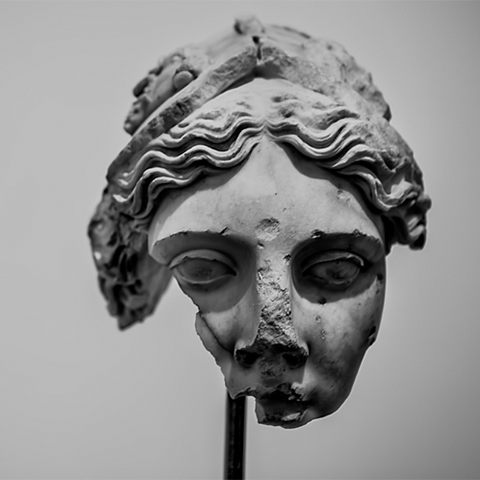
Good Breeding by Robert O’Hara is a retelling of the Oresteia by Aeschylus that centers the female characters of Electra, Clytaemnestra, Helen, and Cassandra—as opposed to the traditional male narrative of Orestes. It is a darkly comic and wildly contemporary adaptation of a classical tale of betrayal, love, revenge, bloodshed, and intergenerational trauma, told through a modern lens. The play seeks to answer the questions: What is free will? Is our fate predetermined? And, how do our choices define who we are?
A human, Tantalus, wanting to gain the power of the Gods, does the unimaginable and serves them a soup unknowingly made from the body of his child. In retaliation, he and his entire family line are cursed for all time. Years later, war has come to Greece, and Helen, the sister of Queen Clytemnestra, has been taken hostage by the city of Troy. Clytemnestra’s husband, Agamemmnon (who is descended from Tantalus), is told by the Gods that if he wants to send troops across the sea to rescue Helen, he must sacrifice his daughter. Clytemnestra, enraged, retaliates with the fury of a mother in pain—coupled with the power of a goddess—and declares war on her husband and the ruling male Senate, slaughtering them all. Her remaining daughter, Electra, avenges the death of her father and sister, and in turn kills her mother. She is tried for this crime, but before she can receive judgement, she escapes to the Underworld to free her mother, father, and sister from the clutches of death. She then turns her sights on the true culprit of all of their troubles, vowing to make him pay for the heartache and struggles of all of humanity: Zeus, the king of the Gods.
CONTENT ADVISORY: Good Breeding contains mature themes. This production includes explicit language, sexual content, and simulated sexual acts. There are also moments of violence, references to war, and potential partial nudity. The play explores themes of complex power dynamics and intergenerational trauma, and features an irreverent, darkly comedic treatment of classical mythology.
Good Breeding is presented through special arrangement with the playwright. Any video and/or audio recording of this production is strictly prohibited.
Program Information
Director's Note
“We make choices from the choices that are chosen for us.”
Every time I read a script as a director, there’s always at least one line that stands out as the thesis statement of the piece. “Who’s there?” in Hamlet. “Attention must be paid” in Death of a Salesman. “The great work begins” in Angels in America. In Robert O’Hara’s Good Breeding, the line that stands out to me as the idea that we are wrestling with is: “We make choices … from the choices … that are chosen for us.” When tackling an adaptation of a thousands-year-old play, we have to find things that can grab us as artists—something for us to hold onto as we find ourselves trying to find the solid ground for us to stand on. For me, this play is all about free will, intergenerational trauma, and how we navigate both of those ideas in conversation—and conflict—with each other. I have always loved Greek mythology, and the stories of humans interacting with the otherworldly. What I appreciate so much about O’Hara’s play is how human everyone feels; how messy it is to actually take a look at who we are in a relationship with. These characters, Gods and mortals alike, spend so much time fighting to be seen for who they are that they are missing the introspective work that could allow them to be fully authentic to who they are. Electra is so focused on vengeance that she never stops to question: Why?
My partner is both an acting professor, certified Alexander Technique teacher, and a trauma specialist. She has taught me—and many of our students at the Conservatory—about Benjamin Libet’s neuroscience theory of “free won’t.” Essentially, the idea is that the capacity for free will is something that is inherent in humans, but we also have free won’t, which is the brain’s ability to make a conscious decision whether or not to respond to a stimulus. In O’Hara’s play, Electra, and so many other characters, are all fighting for free will, for the opportunity to make their own decisions and chart their own destinies beyond what may have been set in motion for them. What might have served her, and them, better would have been to pause and understand that we all have the power of choice. We can choose how we respond to any external or internal stimulus. If we truly do make choices, from the choices that are chosen for us, then we already have the power to chart our own destinies. We already have the power to defy fate and choose our own path. We already have the ability to break the cycle of intergenerational trauma. We can be free to live how we choose.
Is there anything more human than that?
—Christopher Webb
Dramaturgy Note
Robert O’Hara’s Good Breeding takes its inspiration from Aeschylus’ Oresteia, a trilogy of classical Greek tragedies first performed in 458 BCE at the Theatre of Dionysus in Athens. Together, the three plays—Agamemnon, The Libation Bearers, and The Eumenides—illustrate the evolution of the modern justice system by charting the long and violent collapse of the House of Atreus. The myth itself is brutal and cyclical: Agamemnon returns from the Trojan War and is murdered by his wife, Clytemnestra, in retaliation for his earlier sacrifice of their daughter to the gods. Their son, Orestes, is then commanded by Apollo to kill his mother in return, a crime that results in the first-ever jury trial in Athens. What began as familial violence ultimately spirals into a public trial that replaces blood vengeance with the institution of civic law. In the hands of O’Hara, however, this narrative of an ancient family tragedy is reshaped into a defiantly feminist interrogation of the ways in which female power is feared, contained, and ultimately silenced by the systems that claim to bring “order.”
All three plays of the Oresteia are deeply concerned with the struggle between masculine and feminine forms of power, specifically the ways in which that authority is exercised and subsequently justified. In Agamemnon, Clytemnestra rules Argos in her husband’s absence. When Agamemnon returns, she refuses to relinquish her position just because a man has come home. While the murder of her husband is certainly motivated by the residual grief and anger over her daughter’s killing, the act itself is not executed emotionally; it is cold and calculated. Clytemnestra insists that her revenge is justified, presenting herself not as a criminal but as an instrument of justice, almost divine in her authority.
In The Libation Bearers, Orestes is ordered by the gods to kill his mother, but is reluctant to actually do the deed. It is ultimately the overwhelming rage of the women around him—Electra and the all-female chorus—that gives that command its force and pushes Orestes to act. By the time we reach The Eumenides, the gendered struggle for power becomes explicit. In this piece, the Furies represent a primordial form of maternal justice, and they relentlessly pursue Orestes to avenge his matricidal blood crime. Though his trial is presided over by Athena, a female deity, she is traditionally aligned with “masculine” power and openly dismisses the primacy of the maternal bond. She sides with Orestes and, while she preserves the Furies as a female collective, Athena shifts their role from avengers to protectors. Feminine power thus becomes institutionalized and subordinated to male-governed law.
From a feminist perspective, the Oresteia does not simply show the birth of modern civic law—it performs the cost of that birth. Justice is only achieved by redefining the meaning of the word itself, by silencing or redirecting female authority so that it no longer threatens the state. The trilogy leaves us with the uneasy sense that “law and order” are built not on equality, but on containment.
Good Breeding interrogates the fallout of this modern judicial experiment. O’Hara’s adaptation centers the voices that the classical narrative works to quiet: female rage, maternal power, and the pain that refuses to be made small. Rather than celebrating the triumph of civic order, the play asks what has been lost in the process, and what it means to keep calling something justice when it requires the silencing of anyone who dissents.
—Dr. Megan Stahl
Cast
HOUSE OF ATREUS:
CLYTEMNESTRA / HELEN – Becky Gray
ELECTRA – Romina Khodaverdy
TANTALUS / AGAMEMNON / MENELAUS – Sam Webel
ORESTES – Taimu Onuki
CASSANDRA – Calico Velasco
IPHIGENIA – Ava Schara
PYLADES/CUPID – Darren Sanders
GODS OF OLYMPUS:
ZEUS – Matthew Neal
HERA – Mariella Murillo
APOLLO – Indijhan Richard
ATHENA – Elizabeth Finlayson
THE FURIES – Shannon Hoffman, Sofia Gomez, Olivia Corliss
ACHILLES / OTHERS – Andrew Stout
APHRODITE / OTHERS – Catriona Gallagher
HADES / OTHERS – Noah Colvin
PERSPHONE / OTHERS– Tatiana Arias
ARTEMIS / OTHERS – Sedona Raphael
CHARON / OTHERS – Lila Kay
Production Credits
CREATIVE TEAM:
Director – Christopher Webb
Assistant Director – Sage Futterman
Fight and Intimacy Director – Angie Jepson
Assistant to the Fight and Intimacy Director – Brenna Sincaglia
Dramaturg – Megan Stahl
Scenic and Projections Designer – Justin Lahue
Assistant Scenic Designer – Hayden Bingham
Lighting Designer – Rachael Harned
Sound Designer – David Reiffel
Costume Designer – Malory Stewardson Grillo
THEATER DIVISION LEADERSHIP:
Krisha Marcano, Dean of Theater
Ricardo Coke-Thomas, Chair of Theater
Bridgette Hayes, Assistant Chair of Theater
PRODUCTION STAFF:
Director of Performance Services – Hanna Oravec
Assistant Director of Production – Becca Donald
Stage Manager – Joel Butler
Assistant Stage Manager – Zachary Sayre
Technical Director – Taylor Kaufman
Assistant Technical Director – Caleb D. Harris
Costume Shop Manager – Alison Pugh
Wardrobe Manager – Blue Barber
Wardrobe Assistant – Taz Meyers
Hair and Makeup Technician – Honey Mahoney, Natasha Newcomb
Costume Stock Manager/Draper/Stitcher – Kathy Scott
Draper/Stitcher – Sam Martin, Evan Petrow
Stitcher – Aryn Murphy
Costume Production Assistant – Jackie Olivia
Costume Shop Intern – Gavin Wills
Sound Supervisor – Andrei Radu
Audio Engineer/A1 – Maddy Poston
Temp Audio Engineer/A1 – Jess Hawkins
Audio Assistant /A2 – Kait Kelly
Lighting Supervisor – Jacob Inman
Production Electrician – Nate Morrissey
Props Managers – Hannah Spangler, Sara LaFever
Fly Console Operator – Avery Hunt
Scenery Construction – Wooden Kiwi Productions, Waltham, Massachusetts
Production Technicians – Addie Pates, Jude Riley, Hannah Jope, Hazen Polsonetti, Morgan Rotman, Thomas Fowler, Vir Gupta, Paul Vekiarides, Derek Putnam, Buzz Korolenko, Hannah Ashe, Sami Parazin, Sandy Doll, Nick LaRosa, Mac Weaver
TPP Professor – Cassie Seinuk
STUDENT PRODUCTION STAFF:
Student Assistant Stage Managers – Claire Flynn, Em Ockert
Production Assistants – Judah Woomer, Milo Darlington, Naman Kasana, Valeria Caicedo, Matt Logos, Victoria McDougall, Danny Hernandez, David Balough, Gavin Sexton, Isabelle Costanzo
Costume Assistants – Elizabeth Hillman, Clara Palmadottir, Ellie Sawyer
Fight Captains: Andrew Stout, Elizabeth Finlayson
Intimacy Captain: Catriona Gallagher
CONCERT SERVICES STAFF:
Assistant Director, Concert Services – Luis Herrera
Coordinator, Concert Services – Matthew Carey
Concert Production Manager – Kendall Floyd
Performance Technology Technicians – Sara Pagiaro, Goran Daskalov
Special Thanks
Berklee Physical Plant
Jessica, Henry, and Portia Webb
Boston Conservatory thanks audience members for viewing this program information online. This paperless program saved 4,200 sheets of paper, 449 gallons of water, and 377 pounds of CO2-equivalent greenhouse gas emissions.