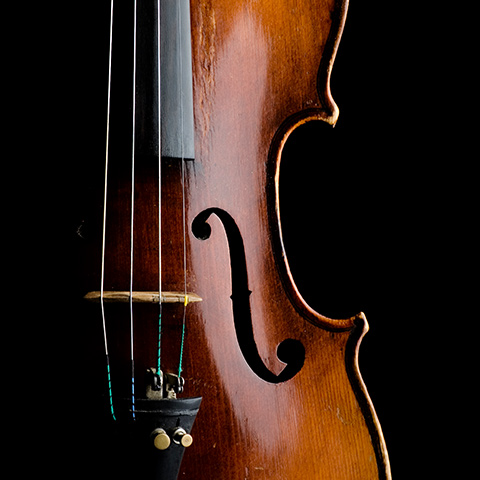
Kathryn Pappalardo (G.P.D. '23) presents a violin recital.
Program Information
Repertoire
DMITRI SHOSTAKOVICH: Four Preludes for Violin & Piano, op.34, arr. Dmitri Tsyganov
I. No.10 - Moderato non troppo
II. No.15 - Allegretto
III. No.16 - Andantino
IV. No.24 - Allegretto
Miles Goldberg, piano
HENRI WIENIAWSKI: Légende, op. 17
Miles Goldberg, piano
JOSEF SUK: Four Pieces for Violin & Piano, op. 17
I. Quasi Ballata
II. Appassionato
III. Un Poco Triste
Miles Goldberg, Piano
EDVARD GRIEG: String Quartet No. 1 in G minor, op. 27
IV. Finale
Jayna Leach (M.M. '24), violin
Drew Keeve (M.M. '24), viola
Andrés Celis (B.M. '25), cello
Program Notes
J.S. BACH: Violin Partita No. 1 in B Minor, BWV. 1002 (1720)
One of six works for unaccompanied violin composed by J.S. Bach, the Partita No. 1 in B Minor is a suite of four baroque dances in which each dance movement is followed by a corresponding double. Each double acts as an expansion and variation of the preceding dance and follows similar harmonic patterns. The partita begins with an Allemanda which has a stately feel, characterized by dotted rhythms that are often interrupted by slurred triplet figures that add an improvisatory feeling to the work. The Corrante is written in three-four time and alternates between separated and more lyrical, slurred notes. In the development, Bach changes the placement of the slur, creating an off-kilter feel. The following double, a perpetual motion composed of mostly 16th notes, is marked “Presto” which translates to “very fast.” The Sarabande, also in three, is the slowest and most introspective movement. It is characterized by the emphasis on beat two of each measure, instead of beat one as in the preceding Corrente. The following double has an ethereal feel. The work concludes with a lively Tempo di Bourrée, filled with multi-voice lines, and a corresponding double which expands the chords into single-note lines.
J. BRAHMS: Sonata for Piano and Violin in G Major, op. 78 (1878-1879)
Brahms’s Sonata for Piano and Violin in G Major was composed during the summers of 1878–1879. The work is subtitled “Regensonate” or “Rain Sonata.” The first movement begins with quiet piano chords, and the descending melody line when the violin enters seems to imitate gently falling summertime rain. A stormy development section returns gently to the wistful mood of the opening. The second movement consists of a lyrical melody shared by violin and piano that is juxtaposed with a mid-movement funeral march. The third movement recalls the opening of the first movement with a “sped up” version of the rhythmic figure. The piano and violin parts are full 16th-note lines that suggest rain yet again, throughout. A direct quote of the melodic theme from the second movement is followed by a build to the peak of the movement, before winding down to a more serene state that brings the work to a close.
Concert Services Staff
Senior Manager of Concert Services – Luis Herrera
Concert Production Coordinator – Matthew Carey
Concert Production Manager – Kendall Floyd
Manager of Performance Technology – Wes Fowler
Performance Technology Technicians – Sara Pagiaro, Goran Daskalov
Boston Conservatory thanks audience members for viewing this program information online. This paperless program saved 130 sheets of paper, 14 gallons of water, and 12 pounds of CO2-equivalent greenhouse gas emissions.