
Boston Conservatory Conductors’ Choir: Schelle to Shaw
Please see the events listing for upcoming events.
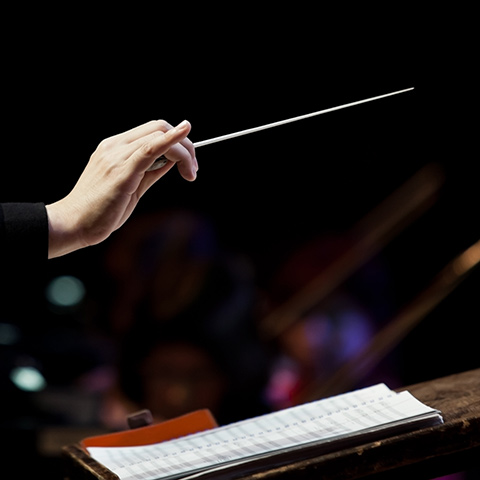
Boston Conservatory Conductors’ Choir welcomes acclaimed guest artists Metropolitan Opera baritone Levi Hernandez and viola da gamba specialist David Miller for an evening of baroque-inspired music conducted by Boston Conservatory graduate choral conducting students.
The program will feature the East Coast premiere of Johann Schelle's "Gott, sende dein Licht," reconstructed and edited by Boston Conservatory faculty member Stephen Spinelli, as well as movements from Caroline Shaw's "To the Hands."
Conducted by Stephen Spinelli and Naomi Bennett (M.M. '24, choral conducting)
Program Information
Repertoire
Piece to be announced from the stage
David Miller, viola da gamba
HENRY PURCELL: “Evening Hymn”
Levi Hernandez, baritone
JOHANN SCHELLE: “Gott, Sende dein Licht”
Viola Kovacs, soprano aria
Joseph Kinglsey, alto aria
Sam Crosby-Schmidt, tenor aria
Levi Hernandez, bass aria
DIETERICH BUXTEHUDE: “Alles was ihr tut”—Conducted by Naomi Bennett (M.M. '24, choral conducting)
Merced Stratton, alto aria
Levi Hernandez, bass aria
CAROLINE SHAW: “To the Hands”
I. Prelude
II. in medio/in the midst
URMAS SISASK: “Püha” (Sanctus from Estonian Mass)
NAOMI BENNETT: “If You Need Me, I’ll Be at the Beach” (2022)—Conducted by Naomi Bennett (M.M. '24, choral conducting)
CAROLINE SHAW: “To the Hands”
VI. i will hold you
Program Notes, Texts, and Translations
HENRY PURCELL: “Evening Hymn”
A pivotal figure in the development of the British Baroque, Henry Purcell brought a deft hand for text-setting, and bold use of expressive dissonance. Before his untimely death at the age of 36, Purcell had the honor of composing the music for the coronation of King James II and the funeral music for Queen Mary II.
“Evening Hymn” is the opening work of Henry Playford's 1688 collection Harmonia Sacraand and sets words by Dr. William Fuller, the late Lord-Bishop of Lincoln, published in Nahum Tate's collection of moralizing poems for children Miscellanea Sacra.
Evening Hymn
Now that the Sun hath veil'd his Light,
And bid the World good Night;
To the soft Bed, my Body I dispose,
But where shall my Soul repose?
Dear God, even in Thy Arms, and can there be
Any so sweet Security!
Then to thy Rest, O my Soul!
And singing, praise the Mercy that prolongs thy Days.
Hallelujah!
JOHANN SCHELLE: “Gott, Sende dein Licht”
Research into Schelle’s life and legacy provides a beautiful and illuminating glimpse at the often overlooked traditions of late 17th-century Lutheran music. Schelle sang for Schütz in Dresden as a boy until his voice changed, at which point he attended the Thomasschule and sang at the Thomaskirche, Leipzig. He became, fairly quickly, the thomaskantor (music director) of the famed Thomaskirche, which would later be Johann Sebastian Bach’s final and most significant place of employment. Schelle served the Thomaskirche for nearly a quarter of a century, providing service music, leading the choirs, and teaching at the associated school. The bulk of Schelle’s music was unpublished, hand copied on yellowed, Baroque manuscripts, and lying in the basements of Saxon libraries. Gott, sende dein Licht is one of four works by Schelle that I have edited and modernized, all of which are cast in a particular pre-cantata form: the concerto-aria. An Italianate concerto—full of text painting, polyphony, and virtuosic singing—is reserved for the presentation of well-known Biblical texts that would have been familiar to the listener. Arias, reserved for the setting of originally composed German poetry, were meant to highlight the syntax of the German text.
Though “Gott, sende dein Licht” received its North American premiere last March at Northwestern University, it is our pleasure to present the first performance of this work in this timezone.
—Stephen Spinelli, conductor
Gott, sende dein Licht
Gott / sende dein Licht und deine Warheit /
God, send your light and your truth,
daß sie mich leiten und bringen
that they may lead me and bring me
zu deinem heiligen Berge
to your holy mountains
und zu deiner Wohnung!
and your dwelling.
Jacobs Stern, du Licht der Heiden,
Jacob’s star, you light of the heathens,
gehe doch in mir auch auf,
rise also in me,
dass ich meines Glaubens Lauf
so that my path of faith
führe selig und mit Freuden!
guides me with blessing and joy!
Weise die Wege,
Guide the way,
zeige die Stege,
reveal the path,
mache mich tüchtig,
make me able,
führe mich richtig,
lead me justly,
dass mich nichts von dir kann scheiden!
so nothing can separate me from you.
Meine Finsternis verschwindet,
My darkness vanishes
wann dein Glanz mich lichte macht,
when your brilliance illuminates me,
dass mein Herz auch bei der Nacht
so that even at night
deine klare Wohnung findet.
my heart finds your clear home.
Weise die Wege,
Guide the way,
zeige die Stege,
reveal the path,
mache mich tüchtig,
make me able,
führe mich richtig,
lead me justly,
dass mich nicht ein Irrtum bindet!
so that I am bound to no fallacy.
Schau, ich bringe dir Geschenke:
See, I bring you gifts:
Buße, beten, Lob und Dank,
repentance, prayers, and thanksgiving,
und ein Herz in Liebe krank,
and a heart weakened in lovesickness
wann ich, Jesu, dich gedenke.
when I remember you, Jesus.
Weise die Wege,
Guide the way,
zeige die Stege,
reveal the path,
mache mich tüchtig,
make me able,
führe mich richtig,
lead me justly,
dass mich nichts nicht von dir lenke!
so that nothing pulls me away from you.
Ja, weil ich mich dir ergebe,
Yes, as I offer myself to you,
So hör auch mein Seufzen an!
hear also my sighs!
Leite mich auf rechter Bahn,
Lead me to the just path
dass ich dir nicht widerstrebe!
that I shall not resist you.
Weise die Wege,
Guide the way,
zeige die Stege,
reveal the path
mache mich tüchtig,
make me able,
führe mich richtig,
lead me justly,
dass ich ewig mit dir lebe!
so I may live with you forever.
DIETERICH BUXTEHUDE: “Alles was ihr tut”
From 1668 until his death in 1707, Dietrich Buxtehude held one of the most important musical positions in North Germany as the organist at the Marienkirche in Lübeck. Buxtehude's virtuosity at the keyboard was so well-known that a young Johann Sebastian Bach took leave from his position in Arnstadt and traveled 250 miles in order to hear a 68 year-old Buxtehude perform. Buxtehude also gained recognition as the driving force behind the Marienkirche's Abendmusik, a concert series featuring his keyboard, choral, and orchestral compositions. The success of the series drew great attention to his music, necessitating the church's construction of four additional balconies to house more performers and spectators.
“Alles was ihr tut,” also cast in the concerto-aria form, demonstrates a burgeoning Lutheran musical identity. Buxtehude employs a variety of forces, presenting instrumental, choral, and solo movements in a manner that would become typical of the Lutheran church cantata. The libretto of the cantata combines texts from the Old and New Testaments, German poetry, and portions of a Lutheran chorale. Buxtehude’s music also reflects the influence of a popular Italian musical practice, in which basso continuo became a fundamental component of ensembles, and text-driven decisions dominated musical composition. Madrigalisms appear throughout this cantata; the word höchster (“most high”) is set as the highest pitch of its musical verse, and melismatic textures embellish the word danket (“thanks”), depicting an outpouring of gratitude. The string ensemble jubilantly responds as the chorus sings, “let all instruments ring out.” The joyful concerto-aria demonstrates the virtuosic and forward-looking tendencies of Buxtehude’s music. One can hear the beginnings of what we will come to know as the Bach cantatas in virtuosic vocal melismas, a mixture of free composition and chorale basis, and a mixture of styles that was truly adventurous for the time.
II. Concerto
Alles, was ihr tut mit Worten oder mit Werken,
Whatever you do with in word or in deed,
das tut alles im Namen Jesu,
do all in the name of Jesus,
und danket Gott und dem Vater durch ihn.
giving thanks to God and the Father by him.
IV. Aria
Dir, dir Höchster, dir alleine,
To thee, to thee most high, to thee alone,
alles, Alleshöchster, dir,
all things, Most High, for thee,
Sinnen, Kräfte und Begier
mind, will, and strength
ich nur aufzuopfern meine,
I sacrifice mine to thee wholly
Alles sei nach aller Pflicht
my senses, strength, and desires.
nur zu deinem Preis gericht.
May everything be solely in praise of you.
Helft mir spielen, jauchzen, singen,
Help me to play, shout, and sing;
hebt die Herzen himmelan,
lift our hears heavenward,
jubele, was jubeln kann,
let them rejoice who can rejoice,
lasst all’ Instrumenten klingen.
let all the instruments ring out.
Alles sei nach aller Pflicht
May everything, in fulfillment of all duty,
nur zu deinem Preis gericht.
Be directed solely to your praise.
Vater, hilf uns Jesu willen,
Father, help us for Jesus’s sake;
lass das Loben löblich sein
let our praises be worthy
und zum Himmel dringen ein,
and penetrate into heaven
unser Wünschen zu erfüllen,
in order to fulfill our desires,
dass dein Herz nach Vaterspflicht
so that you heart, in accord with paternal duty,
sei zu unserm Heil gericht.
might contribute to our salvation.
V. Arioso
Habe deine Lust am Hernn,
Delight in the Lord,
der wird dir geben,
and he will give you
was dein Herz wünscht.
that which your heart desires.
VI. Chorale
Gott will ich lassen raten,
I want to let God,
Denn er all Ding vermag;
who can do all things, counsel me.
er segne meine Taten,
May he bless my deeds,
mein Vernehmen und Sach.
my intentions, and my actions.
Ihm hab’ ich heimgestellt
For I have entrusted to him
mein Leib, mein’ Seel, mein Leben,
my body, my soul, my life,
und was er songst gegeben;
and whatever else he has given me;
er mach’s, wie ihm gefällt.
he will do with it as he pleases.
Darauf so sprech ich Amen
To that I say “Amen”
und zweifle nicht daran:
and I have no doubt:
Gott wird es all’s zusammen
God will let us all
Ihm wohlgefallen lan;
be pleasing to him.
und streck nun aus mein’ Hand,
Therefore I reach out my hand
greif an das Werk mit Freuden,
and joyfully set about the work
dazu mich Gott descheiden
for which God has ordained me
in mein’m Beruf und Stand.
in my vocation and standing.
CAROLINE SHAW: “To the Hands”
Donald Nally, conductor, commissioned “To the Hands” as a response to Ad manus from Dieterich Buxtehude’s 17th-century masterpiece, Membra Jesu Nostri. It is a part of the Seven Responses project and was performed by members of The Crossing, the International Contemporary Ensemble (ICE), and the early music ensemble Quicksilver, alongside the complete Buxtehude and new works by six other composers.
To the Hands begins inside the 17th-century sound of Buxtehude. It expands and colors and breaks this language, as the piece’s core considerations, of the suffering of those around the world seeking refuge, and of our role and responsibility in these global and local crises, gradually come into focus. The prelude turns the tune of Ad manus into a wordless plainchant melody, punctured later by the strings’ introduction of an unsettling pattern.
The second movement fragments Buxtehude’s choral setting of the central question, “quid sunt plagae istae in medio manuum tuarum,” or “what are these wounds in the midst of your hands.” It settles finally on an inversion of the question, so that we reflect upon the question: “What are these wounds in the midst of our hands?” We notice what may have been done to us, but we also question what we have done and what our role has been in these wounds we see before us.
The sixth and final movement unfolds the words in caverna into the tumbling and comforting promise of “ever ever”—“ever ever will I hold you, ever ever will I enfold you.” They could be the words of Christ, or of a parent or friend or lover, or even of a nation.
II. in medio (in the midst)
The following text is from Buxtehude’s “Ad manus, Zechariah 13:6,” adapted by Caroline Shaw, with the addition of in medio manuum nostrarum (“in the midst of our hands”):
Quid sunt plagae istae
What are those wounds?
Quid sunt plagae istae in medio manuum
What are those wounds in the midst of your hands…
Tuarum in medio
in the midst.
Quid sunt plagae istae
What are those wounds?
Quid sunt plagae istae in medio manuum nostrarum
What are those wounds in the midst of our hands?
VI. i will hold you
i would hold you
i would hold you
ever ever will i hold you
ever ever will i enfold you
in medio
in medio
in medio
in medio manuum tuarum
NAOMI BENNETT: “If You Need Me, I’ll Be at the Beach” (2022)
“If You Need Me, I’ll Be at the Beach” is a brief, chorale-style piece about the vast beaches of Southwestern Oregon. The text and music were written in January of 2022. I am a former resident of the Southern Oregon coast, and my favorite pastime was hiking the cliffs and beaches in Coos Bay, where I found inspiration among the rocky, foggy nature. This piece is a practice of mindfulness, to experience the “now” and observe your surroundings with gratitude. No matter how big your problems seem, the ocean is bigger.
—Naomi Bennett (M.M. ’24, Choral Conducting)
If You Need Me, I’ll Be at the Beach
Green ocean wave curl;
White foam, glide across sand and stone.
Cold feet in January,
Steam rising from the sand.
Green ocean wave curl over me;
White foam, crawl across my limbs;
Steam, fill my throat;
Sun, shine too bright and make me close my eyes.
Green ocean wave curl
Over me.
If you need me, I’ll be at the beach.
URMAS SISASK: “Püha” (Sanctus from Estonian Mass)
Seven hundred years of foreign domination came to a head during the mid-20th century, as tens of thousands of Baltic citizens were deported, exiled, or executed. During World War II, as the Third Reich and the Soviets vied for control of the Baltic States, it is estimated that one quarter of Estonia’s population was lost. Soviet presence in Estonia continued into the 1990s.
Since the 1860s, national song festivals have given Baltic cultures a durable strength of identity, even through the harshest political repression. The most powerful of such gatherings occurred in the late 1980s and early 1990s, when more than 300,000 courageous people—more one quarter of all Estonians—gathered at the Laulupidu festival to sing national songs and hymns that were banned by Soviet rule. The peaceful protest has since been dubbed “The Singing Revolution.”
Urmas Sisask studied composition at the Tallinn Conservatory, now the Estonian Academy of Music. He has composed a number of choral works, including three masses. He was commissioned by the Estonian Cultural Council to write an extended work for the 1994 Laulupidu festival. The product was an Estonian-texted Mass that draws from a number of deeply rooted folk idioms, reinforcing the unique linguistic identity of the Estonian people.
Püha, püha, püha on issand,
Holy, holy, holy Lord
Püha on vägede jumal.
Holy God of Hosts.
Taevas ja maa on täis Sinu au,
Heaven and Earth are full of your glory.
Hoosianna korges.
Hosanna in the highest.
Õnnistatud olgu,
Blessed is he,
Kes tuleb Issanda nimel.
who comes in the name of the Lord.
Hoosianna korges.
Hosanna in the highest…
Püha, püha, püha on issand,
Holy, holy, holy Lord
Püha on vägede jumal.
Holy God of Hosts.
Taevas ja maa on täis Sinu au,
Heaven and Earth are full of your glory.
Hoosianna korges.
Hosanna in the highest.
About the Artists
Stephen Spinelli, D.M.A., conductor, is cofounder and director of ONEcomposer, an arts advocacy initiative dedicated to the legacies of historically erased musicians. Through this work, Spinelli has become a prominent champion of the music of underserved composers. He previously served as assistant director of choral programs at Cornell University, and has led a robust performance career, singing with some of the country’s leading contemporary vocal ensembles. Learn more about Spinelli.
Naomi Bennett (M.M. ’24, Choral Conducting), graduate assistant conductor, most recently served as director of choral music at Marshfield High School in Coos Bay, Oregon, and artistic director of the Corvallis Community Choir in Corvallis, Oregon. Bennett received her Bachelor of Arts in music education from Oregon State University in 2020.
Levi Hernandez, bass aria, acclaimed singer with the Metropolitan opera, is a sought-after artist who has performed with several prestigious national and international opera companies. Among his most notable successes are performing the leading roles of Sharpless (Madama Butterfly), opposite Ana María Martínez at Houston Grand Opera; Papageno (The Magic Flute) and the Music Master (Ariadne auf Naxos) at Opera Theatre of Saint Louis; and Guglielmo (Cosí fan tutte) with Spoleto Festival USA. Learn more about Hernandez.
David H. Miller, Ph.D., viola da gamba, is a musicologist and a performer who has appeared with groups such as the Handel and Haydn Society, Arcadia Players, Trinity Wall Street, Music at Marsh Chapel, New York Baroque Incorporated, and Seven Times Salt. He holds a Ph.D. in musicology from Cornell University and writes on issues surrounding the performance and reception of modernist music. Miller is an assistant professor at the University of California, Berkeley. Learn more about Miller.
Caroline Shaw, composer, is a musician who moves among roles, genres, and mediums, trying to imagine a world of sound that has never been heard before but has always existed. She is the recipient of the 2013 Pulitzer Prize in Music, several Grammy awards, an honorary doctorate from Yale, and a Thomas J. Watson Fellowship. She has worked with a range of artists including Rosalía, Renée Fleming, and Yo Yo Ma, and she has contributed music to films and tv series including Fleishman is in Trouble, Bombshell, Yellowjackets, Maid, Dark, and Beyonce’s Homecoming.
Ensemble
CHOIR
Ally Brigley
Tyler Cesario
Naomi Bennett
Violet Hansen
Sam Crosby-Schmidt
Corey Mann
Sidney O’Gorman
Joseph Kingsbury
Viola Kovacs
Raban Brunner
Madison Hablas
Mandy Matthews
Alex Voss
Merced Stratton
Marcea McGuire
ORCHESTRA
Andrea del Aguila, violin
Maria Hodson, violin
Maria Dupree, viola
Morgan Brown, viola
Jean Taglia, cello
Andrea del Aguila, violin I
Maria Hodson, violin II
Maria Dupree, viola I
Morgan Brown, viola II
Jean Taglia, cello
David Miller, viol and double bass
Leona Cheung, continuo
David Miller, viol and double bass
Leona Cheung, continuo
Concert Services Staff
Senior Manager of Concert Services – Luis Herrera
Concert Production Coordinator – Matthew Carey
Concert Production Manager – Kendall Floyd
Senior Manager of Performance Technology – Wes Fowler
Performance Technology Technicians – Sara Pagiaro, Goran Daskalov
Special Thanks
- Leona Cheung
- Isai Jess Muñoz
- Matthew Marsit
- Michael Shinn
- Matt Carey
Boston Conservatory thanks audience members for viewing this program information online. This paperless program saved 130 sheets of paper, 14 gallons of water, and 12 pounds of CO2-equivalent greenhouse gas emissions.