
Artistry in Action: String Masters Series—Curtis Stewart, Violin
This event has passed.
Please see the events listing for upcoming events.
Please see the events listing for upcoming events.
Event Dates
(EDT)
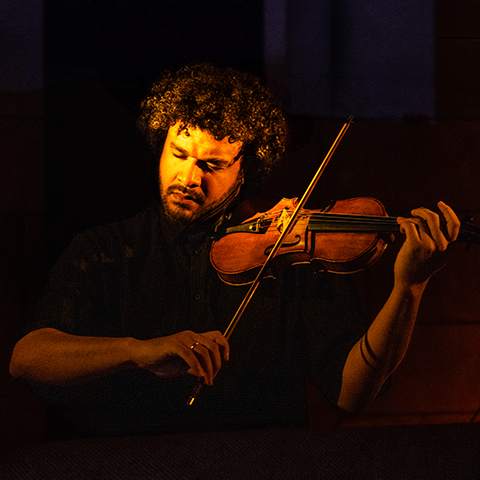
Hailed for his ability to translate stories of American self-determination to the concert stage, seven-time Grammy-nominated violinist and composer Curtis Stewart presents a recital of celebrated and original works, including selections from his 24 American Caprices as part of the String Masters Series.
String Masters Series is artistically directed by Andrew Mark and part of Boston Conservatory at Berklee’s Artistry in Action Series.
Program Information
Repertoire
To be announced from the stage.
Program Notes
Selections from 24 American Caprices
The 24 American Caprices are inspired by a kaleidoscope of recorded American music, with some honorary American additions—musical aspects of each inspiration are abstracted and imbued with challenging violin techniques emulating the sounds and styles of their origin. In the full meaning of “caprice,” these violin fragments dance and sing lightly from inspiration to ornamentation, both with flights of fantasy and fastidious settings of referenced material, creating playful musical dialogue around American lineage and individual perspective in Classical music. Inspired by:
David Bowie, “Modern Love”
Janet Jackson, “Doesn't Really Matter”
“Taps”
JJ Rosamund Johnson,“ Lift Every Voice and Sing”
Bob Dylan, “Blowin’ in the Wind”
Nina Simone, “Young Gifted and Black”
Stevie Wonder, “Isn’t She Lovely”
Aretha Franklin, “Rock Steady”
Selections from of Love.
A digital and personal requiem of sorts, of Love. is a through-composed collection of works to cherish life, time, and lifetimes. Recorded in the childhood apartment inherited after his mother’s passing, Curtis’s original compositions for strings, electronics, and voice weave between a single poem of prayer and songs Curtis’s visionary mother taught him—meditative recompositions of Alice Coltrane, Johannes Brahms, Duke Ellington, Greek folk song, jazz standards, Karol Szymanowski, and Purcell. These works flow directly from the impulses of holding and loss—a caregiver’s sonic grappling with grief, that entangles music and identity—in hopes to hold onto this love just a bit longer.
Seasons of Change—A Recomposition of Vivaldi’s Four Seasons, I. A.Recent.Summer
Seasons of Change, a recomposition of Vivaldi’s Four Seasons, is the frame for an Afro-futurist meditation/dreamscape on climate change, class, and the nature of digital memory, including public conversation and recorded interviews with the unhoused population around the existential impact of climate + infrastructure on our daily lives.
Samuel Coleridge Taylor: Selections from 24 Negro Melodies, I. Deep River (America), arr. Powell/Stewart/Berry
I was drawn to an approach of dealing with the history of slavery within one’s family, the ownership of a name and its “rebranding”—reflecting on the American slave and how Black Americans deal with creating a sense of pride, familial storytelling, and lineage in contemporary America. This notion of “rebranding” extends to the “Negro Melody.” Coleridge-Taylor originally wrote 24 solo piano works based on spirituals and songs from many parts of the world. including Africa and the Americas. My intent with these arrangements is to acknowledge the impact of those melodies on current popular culture, and reflect that influence onto the orchestral stage—to create moments where listeners may participate vocally, with movement, or rhythmically clapping along—to maintain a sense of belonging and recognition—to create community around this music in the classical concert hall—to embrace where all contemporary American concert music extends from, in my belief—America’s mother-music: the Blues.
Stewart’s “I wouldn’t stop there: in the words of a KING” for Violin + Electronics is a paraphrase and fantasy on Martin Luther King’s “Mountaintop” speech—a meditation on the last public words he spoke in 1968 before his assassination. The opening of his speech notes the honor of witnessing humanity’s struggle for freedom—in present tense. Given the option from God, he would stop at no other point in history but the time in which he lived, to participate in that pursuit of freedom.
This work depicts a struggle to feel ownership of our moment in history. It explores a will to resist the impulse to fast forward, to pause, or to be stuck looking to the past for relief; the music provides moments to breathe, alongside incantations summoning the spirit of Dr King; dreamlike atmospheres—akin to nightmares, the energy of running in what feels like a quicksand of forward motion. The text induces an idea from the original words of MLK— there is no time but now, both chaos and stillness exist at once, a splatter and glitch of genre quickly and unpredictably twitches between gospel, Stravinsky, disco, hip-hop, funk, sacred, and atonal classical music—the throughline of determined and graceful rotating rhythmic progress remaining clear behind the jarring static shifts which culminates in a praise dance of conjuring—returning to the breath to keep on keeping on.
History repeats, sometimes when we least expect it—through the noise, we are here. Far from trapped, with access to almost all of human history at our digital fingertips, we remain; here—struggling for freedom, honoring our history by grappling with the now.
(Commissioned by the Virginia Symphony; Eric Jacobsen, music director)
Something is happening in our world. I see God working in this period of the twentieth century in a way that men, in some strange way, are responding.
Something is happening in our world. The masses of people are rising up. We have been forced to a point where we are going to have to grapple with the problems that men have been trying to grapple with through history, but the demands didn’t force them to do it. Survival demands that we grapple with them. Men, for years now, have been talking about war and peace. But now, no longer can they just talk about it. It is no longer a choice between violence and nonviolence in this world; it’s nonviolence or nonexistence. Let us develop a kind of dangerous unselfishness. Let us rise up tonight with a greater readiness. Let us stand with a greater determination. And let us move on in these powerful days, these days of challenge—to make America what it ought to be.
Well, I don’t know what will happen now. We’ve got some difficult days ahead. But it really doesn’t matter with me now, because I’ve been to the mountaintop. And I don’t mind. Like anybody, I would like to live a long life. Longevity has its place. But I’m not concerned about that now. I just want to do God’s will. He’s allowed me to go up to the mountain. I’ve looked over. And I’ve seen the Promised Land. I may not get there with you. But I want you to know tonight, that we, as a people, will get to the promised land!
And so I’m happy tonight.
I’m not worried about anything.
I’m not fearing any man!
Mine eyes have seen the glory of the coming of the Lord!!
The 24 American Caprices are inspired by a kaleidoscope of recorded American music, with some honorary American additions—musical aspects of each inspiration are abstracted and imbued with challenging violin techniques emulating the sounds and styles of their origin. In the full meaning of “caprice,” these violin fragments dance and sing lightly from inspiration to ornamentation, both with flights of fantasy and fastidious settings of referenced material, creating playful musical dialogue around American lineage and individual perspective in Classical music. Inspired by:
David Bowie, “Modern Love”
Janet Jackson, “Doesn't Really Matter”
“Taps”
JJ Rosamund Johnson,“ Lift Every Voice and Sing”
Bob Dylan, “Blowin’ in the Wind”
Nina Simone, “Young Gifted and Black”
Stevie Wonder, “Isn’t She Lovely”
Aretha Franklin, “Rock Steady”
Selections from of Love.
A digital and personal requiem of sorts, of Love. is a through-composed collection of works to cherish life, time, and lifetimes. Recorded in the childhood apartment inherited after his mother’s passing, Curtis’s original compositions for strings, electronics, and voice weave between a single poem of prayer and songs Curtis’s visionary mother taught him—meditative recompositions of Alice Coltrane, Johannes Brahms, Duke Ellington, Greek folk song, jazz standards, Karol Szymanowski, and Purcell. These works flow directly from the impulses of holding and loss—a caregiver’s sonic grappling with grief, that entangles music and identity—in hopes to hold onto this love just a bit longer.
Seasons of Change—A Recomposition of Vivaldi’s Four Seasons, I. A.Recent.Summer
Seasons of Change, a recomposition of Vivaldi’s Four Seasons, is the frame for an Afro-futurist meditation/dreamscape on climate change, class, and the nature of digital memory, including public conversation and recorded interviews with the unhoused population around the existential impact of climate + infrastructure on our daily lives.
Samuel Coleridge Taylor: Selections from 24 Negro Melodies, I. Deep River (America), arr. Powell/Stewart/Berry
I was drawn to an approach of dealing with the history of slavery within one’s family, the ownership of a name and its “rebranding”—reflecting on the American slave and how Black Americans deal with creating a sense of pride, familial storytelling, and lineage in contemporary America. This notion of “rebranding” extends to the “Negro Melody.” Coleridge-Taylor originally wrote 24 solo piano works based on spirituals and songs from many parts of the world. including Africa and the Americas. My intent with these arrangements is to acknowledge the impact of those melodies on current popular culture, and reflect that influence onto the orchestral stage—to create moments where listeners may participate vocally, with movement, or rhythmically clapping along—to maintain a sense of belonging and recognition—to create community around this music in the classical concert hall—to embrace where all contemporary American concert music extends from, in my belief—America’s mother-music: the Blues.
Stewart’s “I wouldn’t stop there: in the words of a KING” for Violin + Electronics is a paraphrase and fantasy on Martin Luther King’s “Mountaintop” speech—a meditation on the last public words he spoke in 1968 before his assassination. The opening of his speech notes the honor of witnessing humanity’s struggle for freedom—in present tense. Given the option from God, he would stop at no other point in history but the time in which he lived, to participate in that pursuit of freedom.
This work depicts a struggle to feel ownership of our moment in history. It explores a will to resist the impulse to fast forward, to pause, or to be stuck looking to the past for relief; the music provides moments to breathe, alongside incantations summoning the spirit of Dr King; dreamlike atmospheres—akin to nightmares, the energy of running in what feels like a quicksand of forward motion. The text induces an idea from the original words of MLK— there is no time but now, both chaos and stillness exist at once, a splatter and glitch of genre quickly and unpredictably twitches between gospel, Stravinsky, disco, hip-hop, funk, sacred, and atonal classical music—the throughline of determined and graceful rotating rhythmic progress remaining clear behind the jarring static shifts which culminates in a praise dance of conjuring—returning to the breath to keep on keeping on.
History repeats, sometimes when we least expect it—through the noise, we are here. Far from trapped, with access to almost all of human history at our digital fingertips, we remain; here—struggling for freedom, honoring our history by grappling with the now.
(Commissioned by the Virginia Symphony; Eric Jacobsen, music director)
Something is happening in our world. I see God working in this period of the twentieth century in a way that men, in some strange way, are responding.
Something is happening in our world. The masses of people are rising up. We have been forced to a point where we are going to have to grapple with the problems that men have been trying to grapple with through history, but the demands didn’t force them to do it. Survival demands that we grapple with them. Men, for years now, have been talking about war and peace. But now, no longer can they just talk about it. It is no longer a choice between violence and nonviolence in this world; it’s nonviolence or nonexistence. Let us develop a kind of dangerous unselfishness. Let us rise up tonight with a greater readiness. Let us stand with a greater determination. And let us move on in these powerful days, these days of challenge—to make America what it ought to be.
Well, I don’t know what will happen now. We’ve got some difficult days ahead. But it really doesn’t matter with me now, because I’ve been to the mountaintop. And I don’t mind. Like anybody, I would like to live a long life. Longevity has its place. But I’m not concerned about that now. I just want to do God’s will. He’s allowed me to go up to the mountain. I’ve looked over. And I’ve seen the Promised Land. I may not get there with you. But I want you to know tonight, that we, as a people, will get to the promised land!
And so I’m happy tonight.
I’m not worried about anything.
I’m not fearing any man!
Mine eyes have seen the glory of the coming of the Lord!!
About the Artists
Praised for “combining omnivory and brilliance” (New York Times), seven-time Grammy-nominated violinist and composer Curtis Stewart translates stories of American self-determination to the concert stage. Tearing down the facade of “classical violinist,” Stewart is in constant pursuit of his musical authenticity, treating art as a battery for realizing citizenship. As a solo violinist, composer, artistic director of the American Composers Orchestra, professor at the Juilliard School, and member of award-winning ensembles PUBLIQuartet and the Mighty Third Rail, he realizes a vision to find personal and powerful connections between styles, cultures, and musics. He was awarded a 2025 Sphinx Medal of Excellence in recognition of extraordinary leaders in the classical music field who are transforming lives while addressing systemic obstacles within Black and Latino communities.
Stewart’s 2025–2026 season includes a performance of Coleridge-Taylor’s Ballade with the National Philharmonic Orchestra; a world premiere at Virginia Symphony Orchestra; commissioning of new American Caprices by American Public Media and Juilliard Pre-College; a performance of the Grammy-nominated of Love., presented by Seattle Symphony; Seasons of Change with Sybarite5 in New York City; appointments as the Hartford Symphony Orchestra’s 2025–2026 Joyce C. Willis Artist in Residence; composer in residence at URI Guitar Festival; and more.
Stewart had multiple albums released in summer 2025: Seasons of Change with Bright Shiny Things; featured soloist in world premiere orchestral recordings by Samuel Coleridge Taylor on AVIE Records, alongside the National Philharmonic under Michael Repper, nominated for two 2026 Grammy Awards; and Sphinx Virtuosi’s summer 2025 album, American Mirror, out with Deutsche Grammophon, which features Stewart’s Drill and Double Down.
As a soloist, Stewart has been presented by Carnegie Hall, Lincoln Center, the Kennedy Center, the Chicago Symphony Orchestra, Cal Performances, Washington Performing Arts, Virginia Arts Festival, the Juilliard School, and the 2022 Grammy Awards, among many others. He has made special appearances with Los Angeles Opera and singer-songwriter Tamar Kali; as curator and guest soloist with Anthony Roth Costanzo and the New York Philharmonic “Bandwagon,” touring performance installations from New York City’s Whitney Museum, Guggenheim Museum, and Museum of Modern Art; on MTV specials with Wyclef Jean; and in sold-out shows at Madison Square Garden with Stevie Wonder, Bruce Springsteen, and Seal.
Stewart has been nominated for multiple Grammy Awards for Best Classical Instrumental Solo. His recording of Julia Perry’s Concerto for Violin and Orchestra with the Experiential Orchestra (Bright Shiny Things) was nominated in 2025. His album of quarantined song cycles and art videos, Of Power (Bright Shiny Things) was nominated in 2021. And, his album of Love.—a tribute to his late mother Elektra Kurtis-Stewart—was nominated in 2023. Stewart’s PUBLIQuartet’s album What Is American (Bright Shiny Things) was nominated for a 2023 Grammy Award as well.
Stewart has been commissioned to compose new solo, chamber, and orchestral works by the Seattle Symphony, Virginia Symphony Orchestra, Phoenix Symphony Orchestra, Carnegie Hall’s Play/USA, countertenor Anthony Roth Costanzo with members of the New York Philharmonic, American Composers Orchestra, Juilliard Prep, the Knights, La Jolla Music Society, Sybarite5, the New York Festival of Song, Newport Classical Festival, the Royal Conservatory of Music, the Eastman Cello Institute, Orlando Philharmonic, Chicago Symphony Orchestra, and more. In 2022, he was named artistic director of the American Composers Orchestra, a national organization dedicated to the creation, celebration, performance, and promotion of orchestral music by diverse and innovative American composers.
An enthusiastic educator, Curtis Stewart currently teaches at the Juilliard School and the Perlman Music Program, and for 10 years led all levels of music theory and orchestra at the LaGuardia High School for Music and Art and Performing Arts in New York City. Learn more about Curtis.
Stewart’s 2025–2026 season includes a performance of Coleridge-Taylor’s Ballade with the National Philharmonic Orchestra; a world premiere at Virginia Symphony Orchestra; commissioning of new American Caprices by American Public Media and Juilliard Pre-College; a performance of the Grammy-nominated of Love., presented by Seattle Symphony; Seasons of Change with Sybarite5 in New York City; appointments as the Hartford Symphony Orchestra’s 2025–2026 Joyce C. Willis Artist in Residence; composer in residence at URI Guitar Festival; and more.
Stewart had multiple albums released in summer 2025: Seasons of Change with Bright Shiny Things; featured soloist in world premiere orchestral recordings by Samuel Coleridge Taylor on AVIE Records, alongside the National Philharmonic under Michael Repper, nominated for two 2026 Grammy Awards; and Sphinx Virtuosi’s summer 2025 album, American Mirror, out with Deutsche Grammophon, which features Stewart’s Drill and Double Down.
As a soloist, Stewart has been presented by Carnegie Hall, Lincoln Center, the Kennedy Center, the Chicago Symphony Orchestra, Cal Performances, Washington Performing Arts, Virginia Arts Festival, the Juilliard School, and the 2022 Grammy Awards, among many others. He has made special appearances with Los Angeles Opera and singer-songwriter Tamar Kali; as curator and guest soloist with Anthony Roth Costanzo and the New York Philharmonic “Bandwagon,” touring performance installations from New York City’s Whitney Museum, Guggenheim Museum, and Museum of Modern Art; on MTV specials with Wyclef Jean; and in sold-out shows at Madison Square Garden with Stevie Wonder, Bruce Springsteen, and Seal.
Stewart has been nominated for multiple Grammy Awards for Best Classical Instrumental Solo. His recording of Julia Perry’s Concerto for Violin and Orchestra with the Experiential Orchestra (Bright Shiny Things) was nominated in 2025. His album of quarantined song cycles and art videos, Of Power (Bright Shiny Things) was nominated in 2021. And, his album of Love.—a tribute to his late mother Elektra Kurtis-Stewart—was nominated in 2023. Stewart’s PUBLIQuartet’s album What Is American (Bright Shiny Things) was nominated for a 2023 Grammy Award as well.
Stewart has been commissioned to compose new solo, chamber, and orchestral works by the Seattle Symphony, Virginia Symphony Orchestra, Phoenix Symphony Orchestra, Carnegie Hall’s Play/USA, countertenor Anthony Roth Costanzo with members of the New York Philharmonic, American Composers Orchestra, Juilliard Prep, the Knights, La Jolla Music Society, Sybarite5, the New York Festival of Song, Newport Classical Festival, the Royal Conservatory of Music, the Eastman Cello Institute, Orlando Philharmonic, Chicago Symphony Orchestra, and more. In 2022, he was named artistic director of the American Composers Orchestra, a national organization dedicated to the creation, celebration, performance, and promotion of orchestral music by diverse and innovative American composers.
An enthusiastic educator, Curtis Stewart currently teaches at the Juilliard School and the Perlman Music Program, and for 10 years led all levels of music theory and orchestra at the LaGuardia High School for Music and Art and Performing Arts in New York City. Learn more about Curtis.
About the Series
String Masters Series is artistically directed by Andrew Mark and part of Boston Conservatory at Berklee’s Artistry in Action series. The Artistry in Action series celebrates exceptional artists and initiatives that exemplify Boston Conservatory’s core values of excellence, innovation, and community engagement. Hosted by the Conservatory’s Music Division, Artistry in Action brings together the school’s prestigious and long-standing Piano Masters Series, String Masters Series, and Chamber Series with exciting new programming for winds, faculty recitals, and ensemble-in-residences. Learn more and view upcoming Artistry in Action events.
Concert Services Staff
Assistant Director, Concert Services – Luis Herrera
Coordinator, Concert Services – Matthew Carey
Concert Production Manager – Kendall Floyd
Performance Technology Technicians – Sara Pagiaro, Goran Daskalov
Performance Technology Specialist – Andrei Radu
Coordinator, Concert Services – Matthew Carey
Concert Production Manager – Kendall Floyd
Performance Technology Technicians – Sara Pagiaro, Goran Daskalov
Performance Technology Specialist – Andrei Radu
Boston Conservatory thanks audience members for viewing this program information online. This paperless program saved 130 sheets of paper, 14 gallons of water, and 12 pounds of CO2-equivalent greenhouse gas emissions.
Related Categories:
Visiting Artist Events
Music
Share To: